FIELD GUIDE
18 May, 2026 · Reviews & Comparisons
Green vs Red Laser Pointer: What to Compare at Night
A green vs red laser pointer comparison is most useful when it answers two questions: do you need to see a dot on a surface or a beam through the air, and under what lighting? Compare optical output and viewing conditions alongside color before choosing a pointer.
What to compare before buying
- Wavelength: this identifies the color. Light Tracer lists 532 nm green; use the red pointer's own wavelength specification for the other side of the comparison.
- Optical output: compare the mW ratings. A photograph of a different-power pointer does not isolate the effect of color.
- Dot or beam: a spot on a wall and a line visible through the air are different observations. Decide which matters for your intended use.
- Lighting and background: compare in similar conditions, including the surface, distance and viewing angle.
- Battery and controls: compare charging, included accessories and switch operation as well as appearance.
Choosing for astronomy? Our green laser pointer buying guide for stargazing explains the specifications to look for. For the meaning of nm and mW, read the laser wavelength and output guide.
Comparing prices as well as color? Read our green vs red laser pointer price and ownership cost guide to compare batteries, accessories and the complete package.
A comparison needs stated conditions
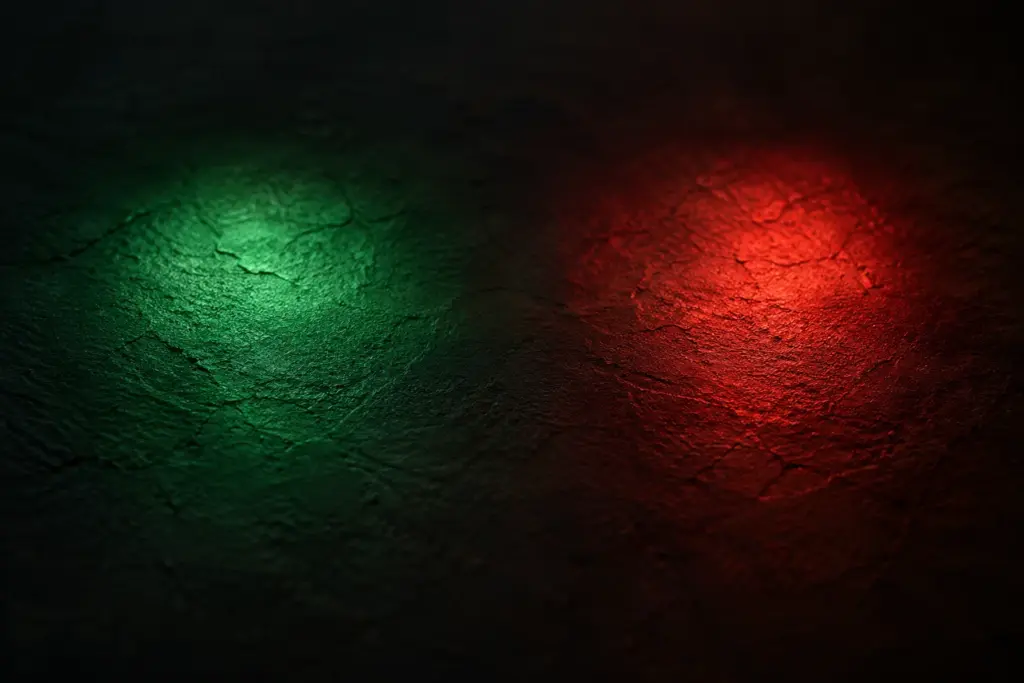
To compare two pointers, identify the devices, output ratings, distance, lighting, and observation method. A green beam shown against a dark sky and a red dot shown in a bright room are not equivalent tests.
Photographs can also use different exposure settings. They do not establish a fixed brightness multiplier, a measured range, or which device is appropriate for a particular use.
What Light Tracer actually lists
Light Tracer's current page describes a 532 nm green pointer with output below 5 mW and a Class 3R classification. Its advertised range is up to 6,000 ft, subject to viewing conditions. The page does not provide a controlled red-versus-green test that establishes a universal performance ratio.
Do not substitute results from a higher-power laser for this product. The visibility guide explains the limits of interpreting the published figures.
Choose for the task, not the most dramatic beam
A pointer can highlight a small area when its path is controlled. It does not provide broad trail lighting, identify a safe route, or establish a dependable emergency signal.
Never point at people, animals, vehicles, aircraft, or reflective surfaces. Keep it away from children and follow the instructions and local restrictions that apply to your use.
Read the buying guide to compare practical features, or check the current Light Tracer specifications and package contents.