The Modern Scarecrow: Using Green Lasers for Agricultural Bird Control
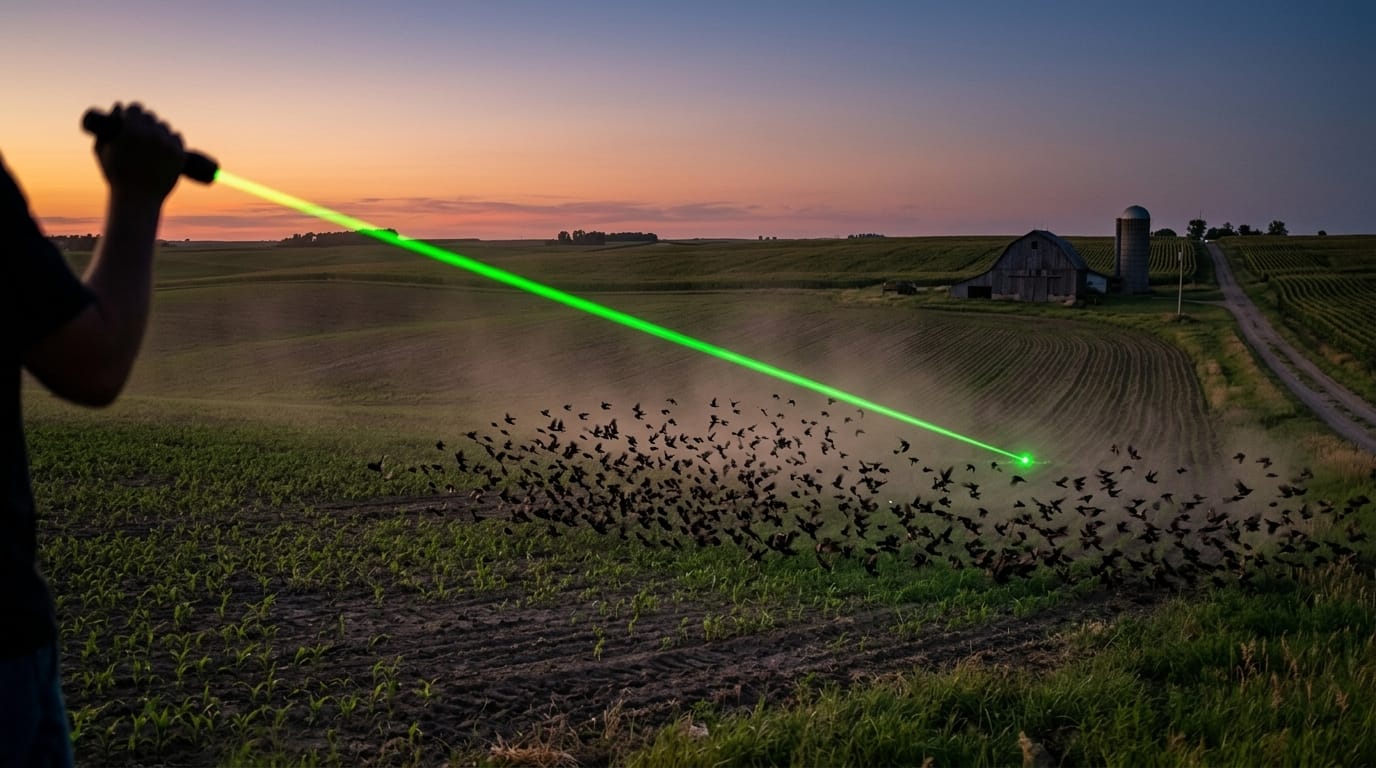
Every year, the global agricultural industry loses millions of dollars in revenue due to crop damage caused by pest birds. Flocks of crows, starlings, and pigeons can decimate a vineyard, orchard, or seed farm in a matter of days. Traditional deterrents like netting, propane cannons, and classic scarecrows are often expensive, disruptive to neighbors, or simply lose their effectiveness as birds adapt.
Today, forward-thinking farmers are turning to a highly efficient, non-lethal, and silent solution: high-power green lasers.
To put the scale of this problem into perspective, studies by the USDA estimate that bird damage costs American agriculture between 150 and 300 million dollars annually. Wine grape growers in California's Napa Valley report losing 10 to 30 percent of their yield to starlings and finches in severe years. Blueberry farmers in the Pacific Northwest face similar pressures from robins and cedar waxwings, while sunflower producers in the Great Plains battle relentless flocks of blackbirds that can consume an entire field's harvest in under a week. Against losses of this magnitude, any tool that offers effective, humane, and affordable protection demands serious attention.
1. The Science of Avian Visual Deterrence
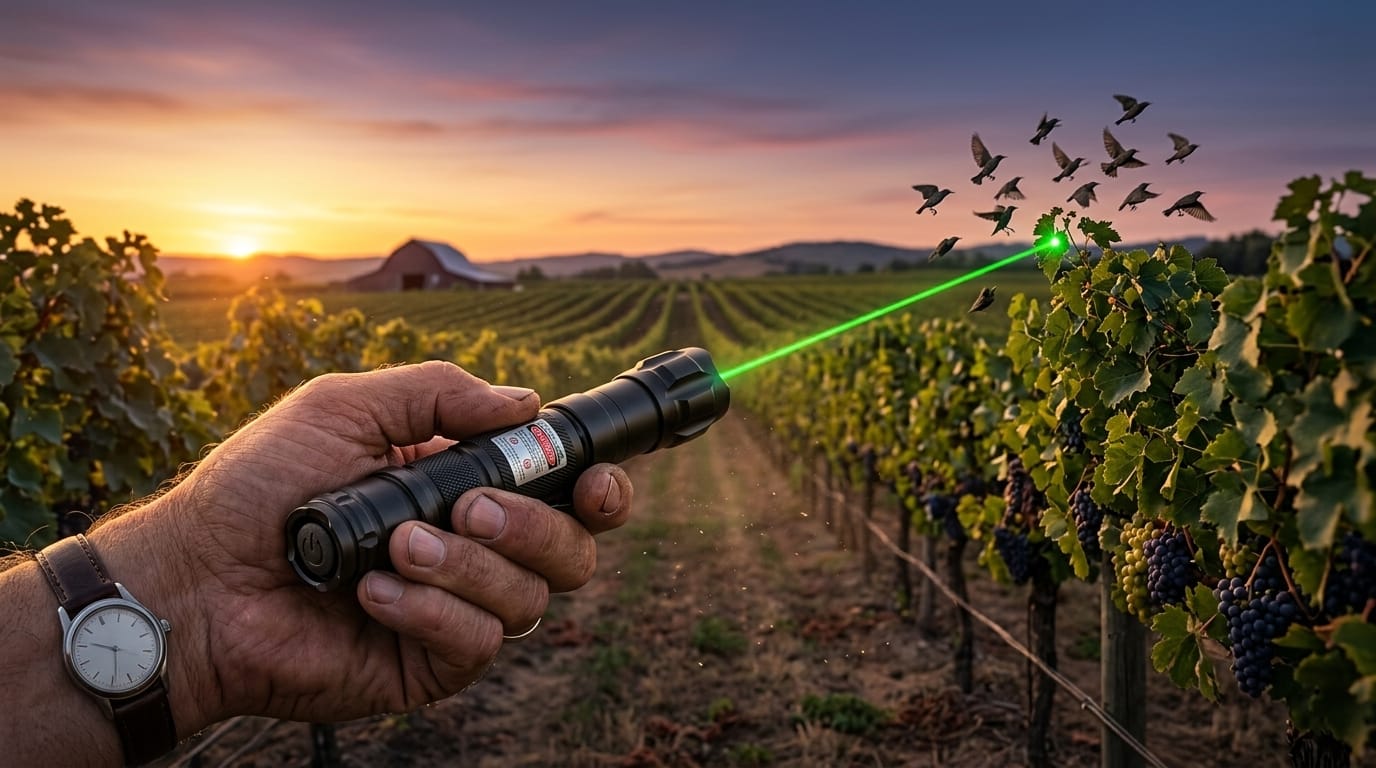
Why do green lasers work so effectively against birds? It comes down to avian biology. Birds have highly developed visual systems and perceive a moving green laser beam not as a beam of light, but as a physical, solid object moving rapidly toward them.
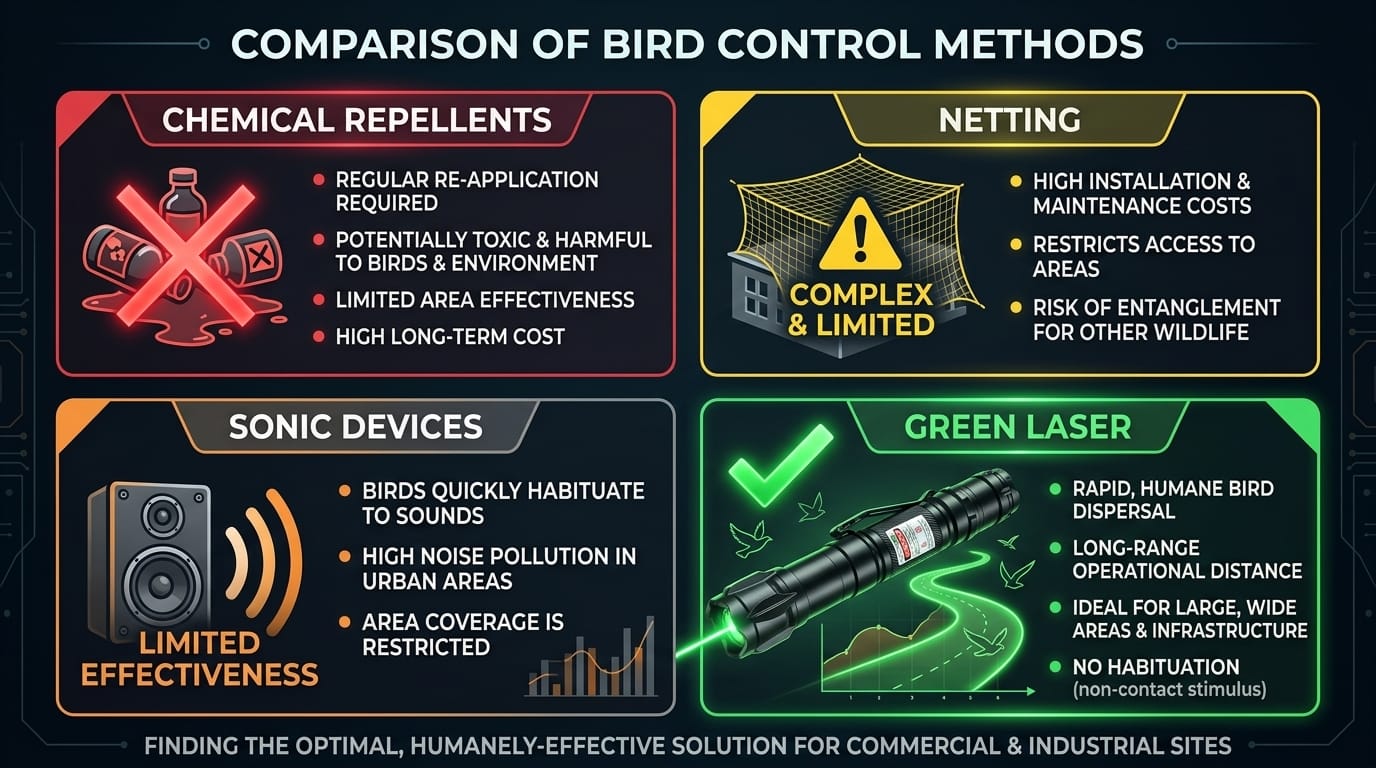
Because the 532nm green wavelength is intensely bright and visually overwhelming to birds, their natural fight-or-flight instinct is triggered immediately. Unlike loud noises which birds eventually get used to (habituation), they never habituate to the perceived physical threat of a sweeping laser beam.
The neurological basis for this response is remarkably consistent across species. Birds possess a specialized retinal structure called the pecten oculi, a vascular comb-like organ that projects into the vitreous humor of the eye. This structure, unique to birds, dramatically enhances their ability to detect motion across their visual field. When a green laser dot moves rapidly across a surface, the pecten amplifies the motion signal, making the dot appear to move even faster than it actually does. From the bird's perspective, the approaching laser is not a curiosity to be investigated—it is an immediate and unambiguous threat demanding evasive action.
Laboratory studies using electroretinography have confirmed that the 532nm wavelength produces the strongest neurological response in the retinal ganglion cells of most pest bird species. This is not a random preference but an evolutionary adaptation: green wavelengths dominate natural environments, and birds have evolved to prioritize green-spectrum visual information for detecting predators against foliage, assessing fruit ripeness, and navigating through complex canopies. A laser weaponizes this evolutionary tuning for deterrence purposes.
2. Key Benefits for Farmers and Vineyard Owners
Replacing or supplementing traditional pest control methods with a high-power tactical green laser offers several massive advantages for agricultural operations:
- Long-Range Area Coverage: A single, high-quality green laser can cover hundreds of acres. You can actively sweep the beam across distant fields from the comfort of your farmhouse or truck, instantly clearing the area.
- Cost-Effective & Eco-Friendly: Say goodbye to buying expensive netting, chemical repellents, or propane. A rechargeable laser requires zero consumables, leaving no toxic residue on your organic crops.
- Silent Operation: Noise ordinances in rural-residential areas can make sonic cannons a legal nightmare. Lasers provide 100% silent pest control, keeping your neighbors happy while protecting your harvest.
- Zero Physical Infrastructure: Installing bird netting over a 50-acre vineyard can cost upwards of $15,000 and requires annual maintenance, repair, and eventual replacement. A laser system eliminates all of this overhead with a one-time equipment purchase.
- Organic Certification Compatibility: Chemical bird repellents containing methyl anthranilate or other active compounds can jeopardize organic certification. Laser deterrence is a purely physical method that complies with all organic farming standards worldwide.
- Scalability Across Farm Sizes: Whether you manage a five-acre hobby orchard or a 500-acre commercial operation, laser technology scales seamlessly. Multiple operators can coordinate sweeps across different sectors simultaneously, or a single operator can patrol sequentially during peak activity windows.
Beyond the financial and operational benefits, there is a growing recognition that humane bird management practices contribute positively to a farm's brand reputation. Consumers increasingly seek out producers who demonstrate environmental stewardship and ethical wildlife practices—a green laser program can become a proud component of your farm's sustainability narrative.
3. Best Practices for Laser Bird Deterrence
For maximum efficacy, timing and technique are crucial. Lasers are most effective during low-light conditions—specifically at dawn and dusk, which precisely aligns with the times birds are actively foraging for food or seeking roosting spots.
Always sweep the beam across the ground or the crop canopy toward the flock, simulating a predator's approach. Ensure you use an aerospace-grade, weather-resistant laser body (IPX4 or higher) so your equipment survives the harsh, dusty, and damp realities of farm work.
Consistency in the early stages of a laser deterrence program is critical to long-term success. Birds are creatures of habit, and they visit agricultural sites in predictable daily patterns. By deploying laser sweeps consistently for the first two to three weeks at dawn and dusk, you effectively break the roosting and foraging habits of the local bird population. Once the birds have learned that your property is an unsafe environment, maintenance sweeps can be reduced to occasional spot-checks, typically requiring only 10 to 15 minutes per session.
Terrain awareness also plays a significant role in sweep effectiveness. On flat, open farmland, a single elevated position—such as a farmhouse balcony or the bed of a pickup truck—can provide enough visibility to cover enormous areas. In hilly or terraced terrain, you may need to plan a mobile patrol route that gives you line-of-sight to all vulnerable crop zones. Some vineyard managers find that mounting the laser on a vehicle and sweeping during a slow perimeter drive achieves the most thorough and time-efficient coverage.
4. Which Crops Benefit Most from Laser Deterrence
While virtually any crop vulnerable to bird damage can benefit from laser deterrence, certain agricultural products see particularly dramatic returns on investment due to their high per-acre value and attractiveness to pest species.
Wine Grapes: Vineyards are perhaps the poster child for laser bird control success. Ripe grapes are irresistible to starlings, robins, and finches, and the high value of premium wine grapes—often exceeding $5,000 per ton—means that even modest damage prevention translates into significant revenue protection. Napa and Sonoma vineyard managers have been early and enthusiastic adopters, reporting that laser programs pay for themselves within the first season.
Blueberries and Cherries: These high-value soft fruits are magnets for avian pests. Unlike grapes, which cluster on vines, blueberries and cherries are individually small, meaning a single bird can consume hundreds of fruits in a single foraging session. The precision and range of laser deterrence allows orchard managers to protect entire blocks without the massive labor cost of installing and maintaining netting over tall cherry trees or sprawling blueberry bushes.
Sunflowers and Grain Crops: Large-scale field crops face different challenges. While the per-acre value is lower, the sheer acreage involved makes traditional deterrents prohibitively expensive. A laser's ability to cover vast distances from a single point makes it one of the few economically viable bird control strategies for large sunflower or grain operations. Farmers report that evening laser sweeps—when blackbirds gather in massive pre-roosting flocks—are particularly effective at preventing overnight crop losses.
5. Integrating Lasers into a Comprehensive Pest Management Plan
The most successful agricultural operations treat laser deterrence not as a standalone solution but as the centerpiece of an integrated pest management strategy. Lasers excel at active dispersal—moving birds off your property quickly and humanely. But combining them with passive deterrents creates a layered defense that addresses the full spectrum of bird pressure.
Consider starting with habitat modification: remove standing water sources that attract birds, keep grass mowed short between crop rows to reduce insect populations that draw insectivorous species, and harvest crops promptly to minimize the window of vulnerability. Add reflective tape, predator decoys, or sonic devices as secondary deterrents that maintain pressure between your active laser sweeps. The laser serves as your high-impact tool for large-scale clearance, while the passive measures maintain a baseline level of deterrence that keeps birds from resettling.
Record-keeping is another underappreciated component of effective laser deterrence. Simple logs tracking the time, location, bird species observed, and laser sweep duration for each session build a valuable dataset over time. Within a single growing season, these records reveal patterns—which crop zones suffer heaviest pressure, which bird species peak at which times, and how weather conditions affect deterrence efficacy—that allow you to refine your strategy for maximum efficiency in subsequent years.
6. Return on Investment for Farms of All Sizes
The economics of laser bird control are compelling at virtually every scale of agricultural operation. A quality tactical green laser with rechargeable batteries and weather-resistant construction costs a fraction of what a single season of netting installation, propane for cannons, or chemical repellent application would require. And unlike consumable deterrents, a well-maintained laser provides years—often a decade or more—of reliable service with minimal ongoing costs.
For a mid-sized vineyard producing 100 tons of grapes annually at $2,000 per ton, preventing even a conservative 10 percent loss to birds saves $20,000 in a single harvest—enough to purchase multiple high-end laser systems and still come out substantially ahead. For smaller operations, the math is equally favorable: a five-acre blueberry farm that prevents $5,000 in bird damage each season recovers the cost of a professional-grade laser within the first year and enjoys pure savings thereafter.
When evaluating ROI, farmers should also factor in the labor savings that lasers provide relative to traditional methods. Netting installation and removal requires significant seasonal labor, chemical application demands repeated passes through the field, and propane cannons need frequent refueling and maintenance. Laser sweeps, by contrast, are quick, clean, and require only one person. Over multiple growing seasons, the cumulative labor savings alone can justify the equipment investment many times over.
The Verdict: Protect Your Yield
Investing in a high-power green laser is one of the smartest, fastest-ROI decisions a modern agricultural professional can make. It is safe, humane, and incredibly effective at keeping your hard-earned crops out of the reach of avian pests.
As the agricultural industry continues to evolve toward more sustainable, humane, and economically efficient practices, green laser technology stands out as a rare triple-win: good for the farmer's bottom line, good for the environment, and good for the birds that are simply following instincts millions of years in the making.
Secure Your Harvest Today
Don't let pest birds eat your profits. Equip your farm with our long-range, ultra-bright green lasers and take control of your fields instantly.
Shop Agricultural Lasers