Lumens vs. Wavelength: Why 532nm Green Lasers Outperform Bright Flashlights

The flashlight industry has convinced everyone that a higher lumen count automatically equals a better outdoor lighting tool. But is that actually the scientific truth?

While a 10,000-lumen flashlight sounds impressive on paper, it often just creates a blinding wall of scattered light. If you need extreme long-distance visibility for stargazing or survival, a 532nm tactical green laser pointer is scientifically superior. Here is the real difference between the two technologies.

Why Lumens Alone Are a Misleading Metric

Before we dive into the physics, let us address the elephant in the room. Lumens measure total light output — the raw volume of photons a device emits in all directions combined. What lumens do not measure is where those photons actually go, how focused they remain over distance, or how efficiently the human eye processes them. A 10,000-lumen floodlight and a 50-milliwatt green laser can both be described by their respective output numbers, but comparing them on output alone is like comparing a garden hose to a fire hose by measuring how much water leaves the nozzle per second — it completely misses the point of what the water actually hits.

Flashlight manufacturers have engaged in a decades-long arms race of ever-increasing lumen numbers because it is the easiest metric to print on a box and the simplest concept for consumers to grasp. But experienced outdoor professionals know that beam quality, collimation, and wavelength are far more important indicators of real-world performance than raw lumen output.

1. The Science of the 532nm Sweet Spot

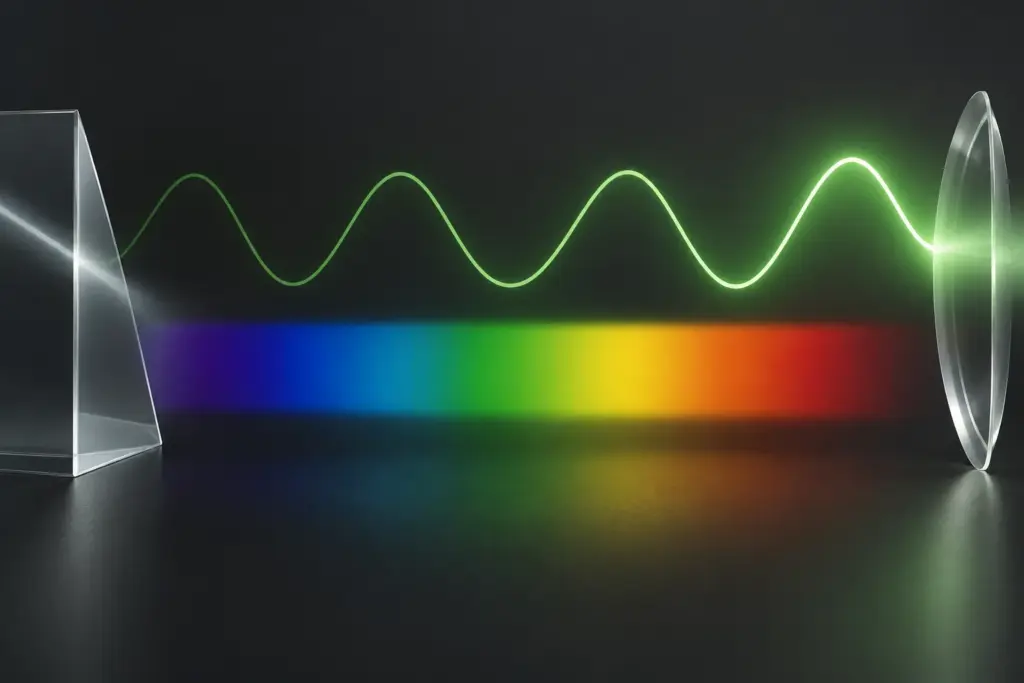
It all comes down to human biology. The human eye is not equally sensitive to all colors of light. Our peak visual sensitivity falls exactly at the 555-nanometer mark, right in the green spectrum during daylight, and shifts slightly at night.

A 532nm green laser operates almost exactly at this biological sweet spot. This means that a green laser beam will appear up to 50 times brighter to the human eye than a red laser of the exact same power output. You get maximum visibility with incredible energy efficiency.

To put numbers behind this claim, the standard photopic luminosity function — the scientific model describing how bright the average human perceives different wavelengths — assigns a sensitivity value of approximately 0.88 at 532nm, compared to just 0.10 at 650nm (red) and 0.03 at 405nm (violet). In practical terms, a 5mW 532nm green laser appears as bright to the human eye as a 44mW red laser or a 147mW violet laser. Every milliwatt of green light works approximately nine times harder than red and nearly thirty times harder than violet in terms of perceived brightness.

This biological efficiency has massive real-world implications. When you are trying to signal across a valley or point out a celestial object during a stargazing session, the green beam does not just look prettier — it delivers dramatically more useful visual information per unit of electrical power consumed.

2. Rayleigh Scattering and the "Lightsaber" Effect

Flashlights use reflectors to throw light, which inevitably spreads out and weakens over distance. Lasers use collimated light, meaning the photons travel in parallel lines without dispersing.

  • The Flashlight Flood: A high-lumen flashlight illuminates everything immediately in front of you, causing severe glare and failing to penetrate deep into the night air.
  • The Laser Beam: Thanks to Rayleigh scattering, the concentrated 532nm green beam interacts with microscopic particles in the air, creating a solid, highly visible line that points directly to your target.
  • Scattering Wavelength Dependence: Rayleigh scattering intensity is inversely proportional to the fourth power of wavelength. Shorter wavelengths scatter far more efficiently, which is why a 532nm green beam is dramatically more visible in the air column than a 650nm red beam — the green light scatters roughly 2.2 times more intensely than red, creating a far brighter and more defined beam path.
  • Humidity Amplification: In humid environments, the green beam becomes even more pronounced. Water vapor particles in the 1 to 10 micron range act as Mie scattering centers, further enhancing the visible beam column without significantly attenuating the beam's forward reach.

This visible beam column is not just aesthetically impressive — it is functionally critical. When you point a flashlight at a distant object, another observer sees only a bright glare at your location. They have no idea what you are pointing at unless you physically walk up and show them. With a green laser, the beam itself draws a literal line through space, connecting you to your target in a way that every nearby observer can immediately understand. This makes group communication, teaching, and coordinated observation infinitely more efficient than any flood light could achieve.

The Inverse Square Law: Why Flashlights Fade So Fast

One of the most brutal realities of optical physics is the inverse square law. For any non-collimated light source like a flashlight, the intensity of light at any given point drops proportionally to the square of the distance from the source. Double the distance, and the light intensity drops to one-quarter. Triple the distance, and it drops to one-ninth. This is why your 1000-lumen flashlight that seems blinding at 10 feet becomes a dim patch of light on a tree trunk at 300 feet.

A collimated laser beam defies the inverse square law to a remarkable degree. Because the photons travel in near-perfect parallel lines, the beam maintains its intensity over extreme distances. A 50mW tactical green laser can put a visible, useful spot on a target a mile away — try that with any handheld flashlight, regardless of its lumen rating, and you will see nothing but scattered, useless photons.

The practical difference is staggering. A top-tier 2000-lumen thrower flashlight with a deep reflector might produce a usable hotspot at 800 meters. A 50mW 532nm laser will produce a crisp, clearly visible dot at 2000 meters and beyond. The laser accomplishes this with a fraction of the power, a fraction of the battery drain, and a fraction of the physical size.

3. Power Consumption and Reliability

Driving a massive LED chip to produce thousands of lumens requires huge amounts of battery power and generates extreme heat. Your "ultra-bright" flashlight will likely step down its brightness within minutes to prevent melting.

A tactical green laser focuses all its energy into a single, highly efficient diode. Housed in an aerospace-grade aluminum body for thermal management, it can sustain a continuous, ultra-bright 6000-foot beam for hours on a single 18650 battery charge without overheating.

Let us break down the electrical reality. A modern high-output LED flashlight running at 3000 lumens draws approximately 10 to 15 watts of electrical power. The LED chip itself converts only about 30 to 40 percent of that energy into light — the rest becomes heat that must be dissipated through the flashlight body. If the thermal path cannot keep up, the driver circuit automatically throttles output, sometimes within 90 seconds of activation on maximum mode. Your "3000-lumen" flashlight is, in practice, a 900-lumen flashlight after two minutes of use.

A DPSS 532nm green laser module, by contrast, draws approximately 1 to 2 watts total to produce its 50mW output beam — the pump diode runs at higher power internally, but the overall electrical consumption is an order of magnitude lower than the flashlight. The aluminum host body easily dissipates this modest thermal load, allowing continuous operation for the full duration of the battery without any thermal step-down. On a single high-quality 18650 cell rated at 3500mAh, expect 4 to 6 hours of continuous beam output — enough for multiple nights of heavy field use.

Beam Divergence: The Ultimate Metric

If there is one number that matters more than lumens for long-range visibility, it is beam divergence — measured in milliradians (mrad). A typical tactical flashlight with a smooth reflector might achieve a beam divergence of 2 to 4 degrees, meaning the beam spreads to roughly 35 to 70 meters wide at 1000 meters distance. By that point, the light density is so diffuse that the human eye cannot distinguish it from ambient darkness.

A quality 532nm green laser has a beam divergence of approximately 1.0 to 1.5 mrad — that is roughly 0.06 to 0.09 degrees. At 1000 meters, the beam has spread to a spot only 1.0 to 1.5 meters in diameter. Every photon of that green light remains concentrated in a tight, visible circle. The difference in effective range between a 2-degree flashlight beam and a 1.5-mrad laser beam is not a factor of two or ten — it is a factor of over a thousand in terms of energy density at the target plane.

This is why even a modest 5mW laser can be visible on a building across a city, while a 500-lumen flashlight barely illuminates the tree across the street. Collimation is not just an advantage — it is the defining characteristic that separates laser technology from every other portable light source ever invented.

Honest Comparison: When Flashlights Still Win

To be fair, flashlights remain superior for several important use cases. If you need to illuminate a wide area — setting up camp in complete darkness, searching for a dropped item in tall grass, or performing first aid on a trail — a flood-style flashlight or headlamp is the only practical choice. A laser's pencil-thin beam is useless for area illumination.

Flashlights also win for close-range navigation where you need to see the ground texture, identify trip hazards at your feet, and maintain general environmental awareness. The laser excels at distance; the flashlight dominates up close. The two tools are not competitors — they are complementary instruments that belong together in any well-equipped outdoor kit. Understanding when to deploy each is the mark of an experienced outdoor professional.

The Verdict: Choose Precision Over Flood

When you need to point out a constellation, signal for help, or identify a distant target, flooding the forest with scattered white light is the wrong approach. For true long-range precision and efficiency, a 532nm green laser is unmatched.

The lumen wars have distracted the outdoor community from what actually matters: putting visible light exactly where you need it, using the wavelengths your eyes evolved to see best, with the collimation that physics demands for true long-range performance. A 6000-foot green laser beam is not a gimmick — it is the logical endpoint of understanding optics, human vision, and energy efficiency. Once you experience the difference between flood and precision, there is no going back.

Experience the 532nm Advantage

Stop relying on inefficient flashlights for long-distance visibility. Upgrade to the scientifically superior 6000ft tactical green laser pointer.

Get the Laser Beam Pro Now
Light Tracer Laser Pointer Thumbnail

Light Tracer Laser Beam Pro

$19.99 $39.99
Ends:
00:00:00