Winter Survival: How Extreme Cold Affects Your 532nm Green Laser
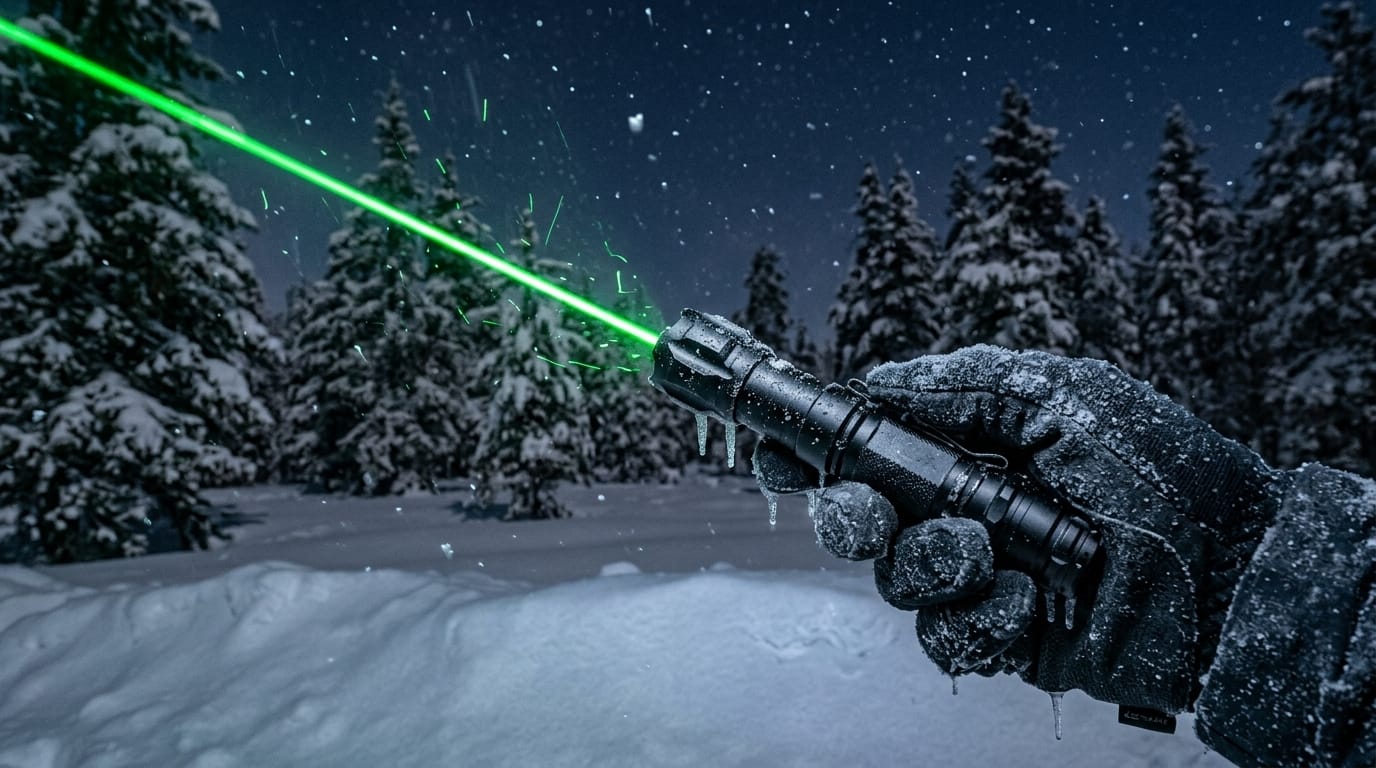
When you pack your gear for a sub-zero winter expedition, you expect your tools to work flawlessly. However, many outdoor enthusiasts are surprised to find that their standard tactical gear behaves differently in freezing temperatures. If you rely on a green laser pointer for winter survival or mountaineering, understanding its cold-weather physics is a matter of life and death.
Unlike simple LED flashlights, 532nm green lasers utilize complex internal optics that react to temperature drops. Here is the scientific breakdown of why cold weather affects your green laser and how to ensure maximum performance in the snow.
Before diving into the technical details, it is worth acknowledging that most winter-related laser failures are completely preventable. They are not caused by inherent design flaws or poor manufacturing but by a knowledge gap—users who understand how to operate their equipment at room temperature but have never been taught how thermal physics changes the equation in extreme environments. The difference between a laser that works flawlessly at -20°C and one that fails to produce any visible beam often comes down to a handful of simple habits that take minutes to learn and seconds to execute. This guide covers them all.
1. The Physics of DPSS Technology in Winter
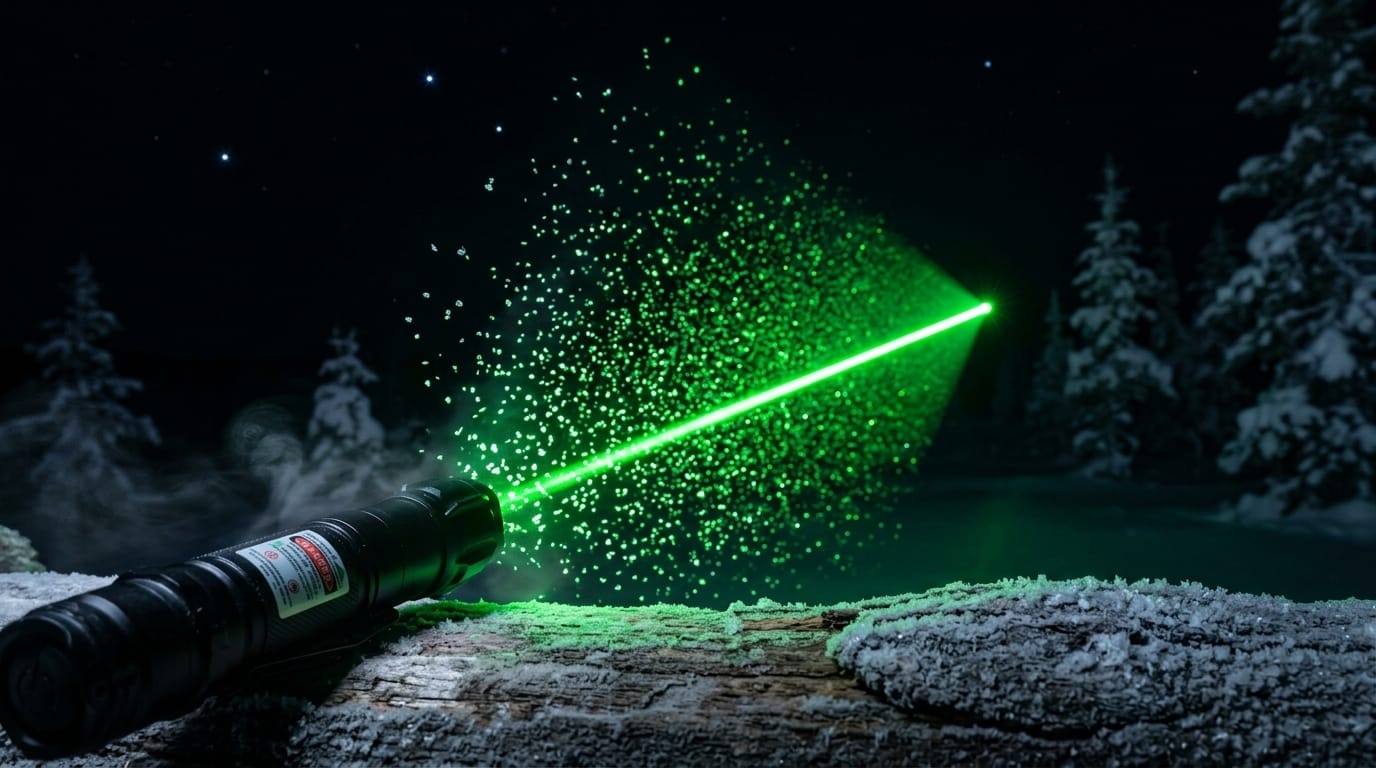
Most high-power 532nm green lasers rely on DPSS (Diode-Pumped Solid State) technology. This involves a primary infrared laser diode (usually 808nm) shining through an Nd:YVO4 crystal and a KTP crystal to convert the invisible infrared beam into a brilliant 532nm green beam.
These precise optical crystals are highly sensitive to thermal changes. In extreme cold (typically below 59°F or 15°C), the crystals can temporarily lose their optimal alignment or conversion efficiency, resulting in a dimmer beam until the unit warms up.
The sensitivity comes from a physical phenomenon called thermal phase matching. DPSS crystals rely on precise refractive index relationships to achieve efficient frequency doubling—converting 1064nm infrared light to 532nm green light. The refractive index of KTP (Potassium Titanyl Phosphate) changes measurably with temperature; at 25°C, the crystal is optimized for peak conversion efficiency, but at 0°C, the same crystal may convert only 30-50% as much IR energy into visible green light. The remaining energy is dissipated as heat within the crystal itself, creating a self-reinforcing problem: the laser becomes dimmer and wastes more energy as internal heat while struggling to reach its optimal operating temperature.
Another cold-induced phenomenon that experienced users recognize is mode hopping—a sudden, visible shift in beam brightness or pattern as the laser's internal resonant cavity jumps between competing oscillation modes. Mode hopping is most common during the warm-up phase when the laser is transitioning from cold-soaked to operating temperature. If you see your beam flicker or suddenly change intensity patterns during the first 30-60 seconds of use in cold weather, this is almost certainly mode hopping rather than a defective unit. Allow the laser to continue running; the behavior typically stabilizes as the crystal temperature equalizes.
2. Battery Voltage Drop in Sub-Zero Climates
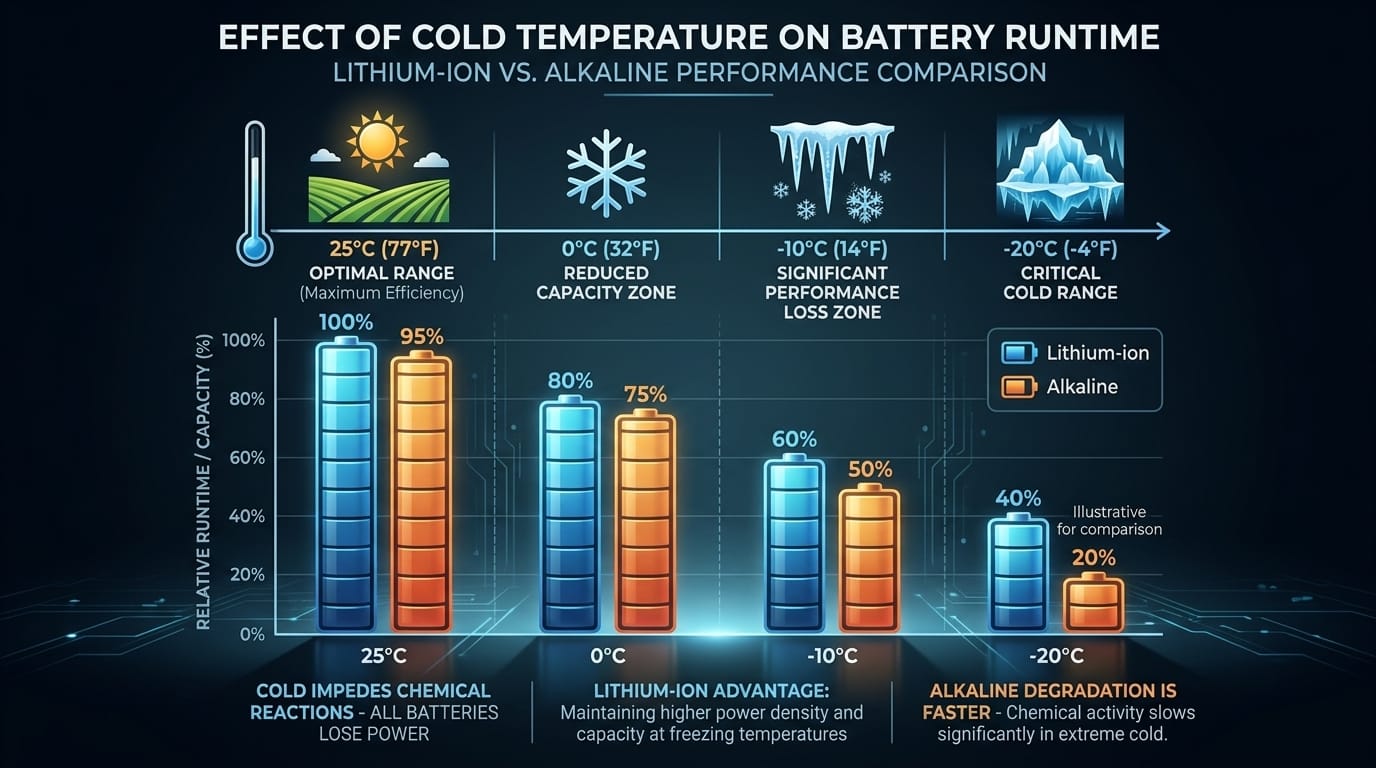
It's not just the laser module that hates the cold; your power source does too. Lithium-ion batteries (like the 18650s commonly used in high-output lasers) experience a significant drop in chemical reaction rates when exposed to freezing temperatures.
- Voltage Sag: The cold increases the internal resistance of the battery, leading to lower voltage output. This means your laser might struggle to draw the power it needs for maximum beam intensity.
- Shorter Lifespan: A battery that lasts 3 hours at room temperature might only last 45 minutes in a blizzard.
- Permanent Capacity Loss: Repeatedly discharging lithium-ion cells at temperatures below -10°C can cause irreversible damage to the anode structure through lithium plating—where metallic lithium deposits form instead of intercalating properly into the graphite. A battery that has been deeply discharged in extreme cold several times may permanently lose 20-40% of its original capacity.
- Charging Danger: Never attempt to recharge a lithium-ion battery that is still cold-soaked below 0°C. The charging process at low temperatures dramatically accelerates lithium plating and can cause internal short circuits, swelling, or in extreme cases, thermal runaway. Always allow batteries to warm to room temperature before connecting them to a charger.
- Voltage Recovery Curve: A battery that reads 2.8V (near-dead) at -15°C may recover to 3.6V (60% charged) after warming. Do not discard batteries that appear depleted in the cold—test them again at room temperature before making replacement decisions.
The chemistry behind this behavior is straightforward but unforgiving. Lithium-ion cells rely on the movement of lithium ions through a liquid electrolyte between the anode and cathode. As temperature drops, the electrolyte's viscosity increases exponentially, slowing ion mobility and increasing the energy required to drive the electrochemical reaction. At -20°C, the effective capacity of a standard 18650 cell drops to approximately 40-50% of its rated capacity, and the maximum discharge current—critical for powering a DPSS laser's initial current spike—can fall below the laser's minimum requirements, causing startup failures even in a fully charged battery. This is why winter-ready batteries from premium manufacturers like Panasonic and Samsung are preferred by experienced cold-weather users; their electrolyte formulations are optimized for a wider temperature range.
3. Pro Tips: Keeping Your Laser Peak-Ready in the Cold
You don't have to abandon your tactical green laser during winter months. By following a few expert survival strategies, you can maintain its 6000-foot signaling capability even in the Arctic:
- Body Heat is Key: Always store the laser pointer in an inner jacket pocket close to your core body heat, rather than in an external backpack pouch.
- The Pre-Warm Technique: If your laser has been sitting in the cold, turn it on and let it run for 30-60 seconds. The internal infrared diode generates its own heat, which will naturally warm the DPSS crystals back to peak efficiency.
- Insulated Battery Carry: Keep spare 18650 batteries in a thermally insulated container or wrapped in a dry sock deep inside your warmest gear.
- Rotate Batteries Strategically: If you carry two batteries, keep one warming against your body while the other powers the laser. Rotate them every 20-30 minutes. This simple protocol can effectively double your usable runtime in sub-zero conditions.
- Use the Laser Itself as a Hand Warmer: During extended standby periods, briefly activate the laser every 10-15 minutes for 5-10 seconds. The waste heat generated internally keeps the crystals closer to their optimal temperature window and prevents complete cold-soaking.
- Morning Preconditioning: If you are camping overnight in freezing conditions, place the laser and spare batteries inside your sleeping bag near your core before going to sleep. Starting the day with a warm unit eliminates the need for a prolonged warm-up period when you may need the laser urgently.
These techniques have been validated by mountaineers, winter search-and-rescue teams, and military personnel operating in Arctic environments. The common principle is thermal management—treating heat as a consumable resource that must be conserved and strategically deployed, much like battery power or drinking water. A laser kept consistently at 15-25°C through active thermal management will perform identically to one operated in a climate-controlled room, regardless of the ambient temperature outside your jacket.
4. Condensation: The Hidden Winter Enemy
While most winter laser discussions focus on the cold itself, a more insidious problem often goes unaddressed: moisture condensation. When you move a cold-soaked laser into a warm environment—a heated tent, a vehicle cabin, or indoors after a long session—the sudden temperature differential causes water vapor in the air to condense on every surface, including the internal optics of your laser.
This condensation is dangerous for two reasons. First, water droplets on the internal crystals or lens surfaces scatter and absorb the laser beam, dramatically reducing output power and creating an ugly, diffuse beam pattern. Second, and more seriously, repeated condensation cycles can cause permanent optical coating damage. The anti-reflective coatings applied to DPSS crystals and collimating lenses are microscopically thin layers of magnesium fluoride or silicon dioxide. When water droplets form and evaporate repeatedly on these surfaces, they leave behind mineral residues that gradually etch the coating, degrading beam quality over time.
The solution is simple and costs nothing: always transition temperatures gradually. Before bringing your laser indoors from the cold, place it in a sealed plastic bag or waterproof pouch while still outside. Then bring the sealed package inside and let it warm to room temperature over 30-60 minutes before opening. The condensation forms on the outside of the bag, not on your laser. For the reverse transition—moving from warm indoors to cold outdoors—keep the laser in your inner jacket pocket during the first 10-15 minutes outside, allowing it to cool gradually rather than experiencing thermal shock. These two habits alone can extend the useful lifespan of your laser's optics by years.
5. Winter Signaling: Maximizing Your Laser's Survival Utility
In a genuine winter survival scenario, a green laser's value extends far beyond casual pointing. Its ability to project a visible beam for hundreds of meters makes it one of the most effective non-radio signaling devices available to a stranded hiker or mountaineer. But using a laser for emergency signaling in winter conditions requires specific techniques that differ from warm-weather operation.
The most effective method is sweeping the horizon, not pointing at a single target. Search aircraft and ground rescue teams are trained to spot unusual light sources against the landscape background, and a slow, deliberate horizontal sweep of a green beam is far more attention-grabbing than a stationary dot. The standard distress pattern is three slow sweeps, pause, repeat. This rhythm is internationally recognized and distinguishes your signal from random laser use. At night during snowfall, aim the beam slightly above the horizon rather than parallel to the ground—falling snow scatters light in all directions, and an angled beam creates a larger visible signature from the air.
For ground-based signaling, use the laser to illuminate your immediate location rather than trying to project the beam toward rescuers. Point the beam at the snow-covered ground near your position or sweep it across nearby tree canopies. The scattered green glow is highly visible at night and helps search parties pinpoint your location without requiring precise beam alignment. If you hear a helicopter, never aim the beam at the aircraft—even in an emergency, blinding a pilot creates a dual emergency. Instead, aim the beam vertically or at the terrain beside you to create a visible column of scattered green light that marks your position safely.
6. Field Data: Cold Weather Performance Benchmarks
To ground this discussion in measurable reality, here are the approximate performance characteristics of a quality 532nm DPSS green laser at various temperature points, assuming standard 18650 batteries:
- 25°C (77°F, Room Temperature): Full rated output within 1-2 seconds of activation. Stable beam with no warm-up period. Battery delivers 100% of rated capacity. Typical runtime: 2.5-3 hours continuous.
- 10°C (50°F): Full output achieved within 5-10 seconds. Slight initial dimming possible during first 3-5 seconds. Battery delivers approximately 85% of rated capacity. Typical runtime: 2-2.5 hours.
- 0°C (32°F, Freezing): Output reaches 70-80% of maximum within 10-15 seconds, gradually climbing to full output over 30-45 seconds as crystals warm. Mode hopping may be visible during warm-up. Battery delivers approximately 65% of rated capacity. Typical runtime: 1.5-2 hours.
- -10°C (14°F): Initial output may be 30-50% of maximum. Full output requires 60-90 seconds of continuous operation to warm crystals. Significant voltage sag from batteries. Mode hopping is common and can persist for 45+ seconds. Battery delivers approximately 45% of rated capacity. Typical runtime: 1-1.5 hours.
- -20°C (-4°F): Laser may fail to start on first attempt. If it starts, initial output is typically 10-20% of maximum and may flicker or pulse erratically. Full output requires 2-3 minutes of continuous operation. Battery may be incapable of delivering sufficient startup current. Typical runtime: 30-60 minutes with a freshly warmed battery.
- -30°C (-22°F) and Below: Reliable operation requires active thermal management. Without pre-warming, most DPSS lasers will not start. Batteries are functionally dead at these temperatures. Only use if the unit has been kept against body heat continuously.
These benchmarks are based on averaging across multiple DPSS laser models from reputable manufacturers. Budget lasers without proper thermal design may perform significantly worse at every temperature point, while premium models with enhanced crystal mounting and temperature-compensating circuitry may perform slightly better. The takeaway is clear: below 0°C, every degree matters, and the difference between a prepared user and an unprepared one becomes starkly apparent.
The Verdict: Preparation Equals Performance
A tactical 532nm green laser remains one of the most powerful signaling tools you can carry into the winter wilderness. As long as you understand the thermal dynamics of DPSS technology and keep your unit reasonably warm, it will slice through winter fog and snowstorms better than any standard flashlight.
If there is one principle to internalize from this guide, it is this: your laser is not a set-and-forget tool in winter. It is a system that includes the device itself, its power source, and your own thermal management behavior. When all three components are operating in harmony—a quality DPSS laser with an IR filter, fresh high-discharge batteries, and the discipline to keep both warm against your body—cold weather becomes an inconvenience rather than a showstopper. The mountaineers who rely on green lasers for winter navigation do not have magical equipment. They have good equipment and great habits. The equipment is available to anyone. The habits are free.
Before your next winter expedition, run through the thermal management checklist one final time: batteries charged and insulated, laser in an inner pocket, a sealed bag ready for condensation control, and the distress signaling patterns committed to memory. These small preparations compound into the difference between a tool that fails when you need it most and one that performs exactly as designed, regardless of what the thermometer says.
Gear Up for Extreme Conditions
Don't let the cold compromise your safety. Equip yourself with an aerospace-aluminum encased tactical green laser built to handle demanding environments.
Get Your Winter-Ready Laser Now