The Silent Sentinel: Using 532nm Green Lasers for Humane Bird Control
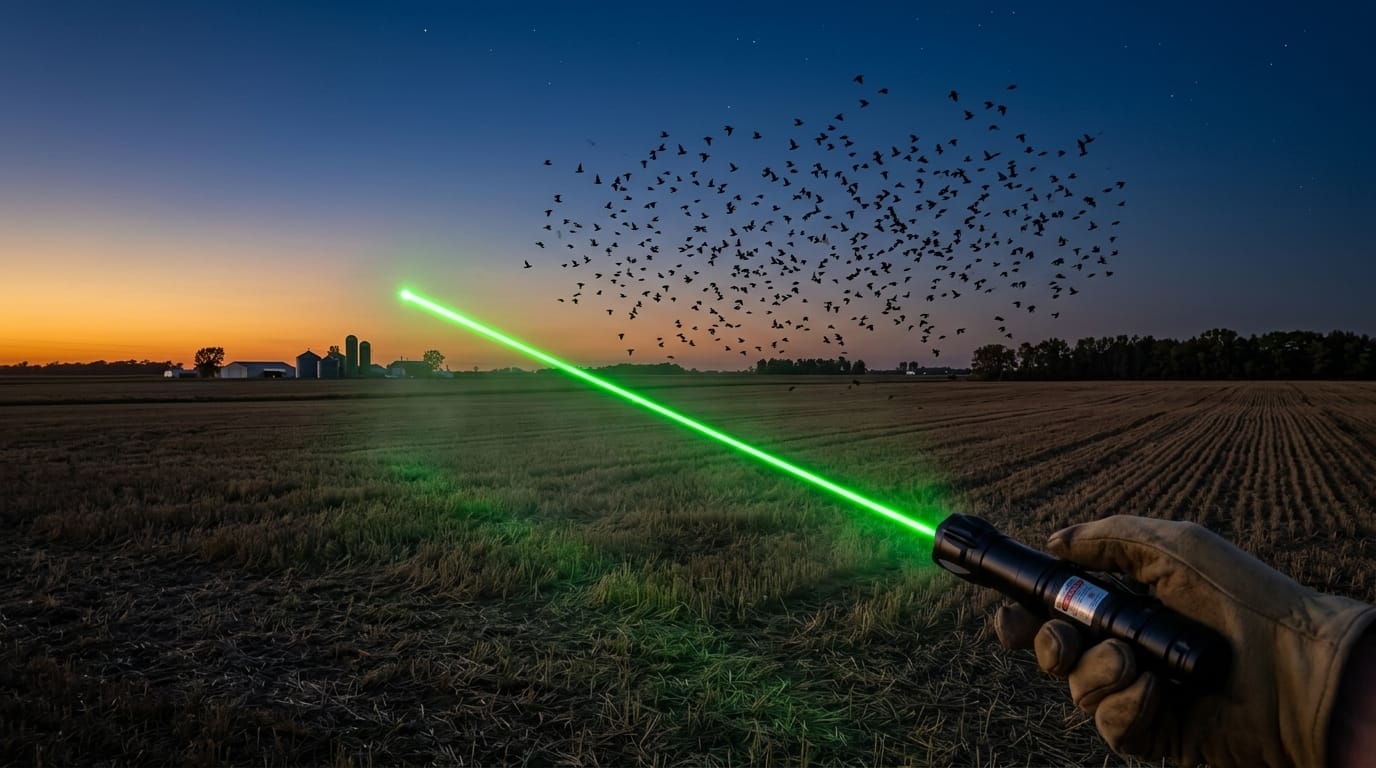
Whether you manage a sprawling vineyard, a commercial farm, or simply want to protect your backyard garden, nuisance birds can cause thousands of dollars in property and crop damage. While most property owners turn to loud propane cannons or chemical repellents, modern agricultural experts are adopting a much smarter tool: the 532nm tactical green laser.
Using lasers as an avian deterrent is not science fiction; it is a scientifically proven, eco-friendly solution that is revolutionizing pest management without causing harm to the animals. Studies conducted by agricultural extension programs across North America and Europe have repeatedly demonstrated that laser-based bird deterrence can reduce crop losses by as much as 70 to 90 percent in heavily affected areas.
Consider this: a single flock of European starlings can number in the tens of thousands and consume up to 20 tons of fruit in a single growing season. For vineyard owners, a flock of robins or cedar waxwings can strip entire vines of ripe grapes in under 48 hours. The financial damage is staggering, yet the solution need not be lethal or chemically intensive. By understanding how birds perceive their environment, we can deploy a tool that speaks directly to their deepest survival instincts—without ever causing them physical harm.
1. Why Birds Fear the Green Beam
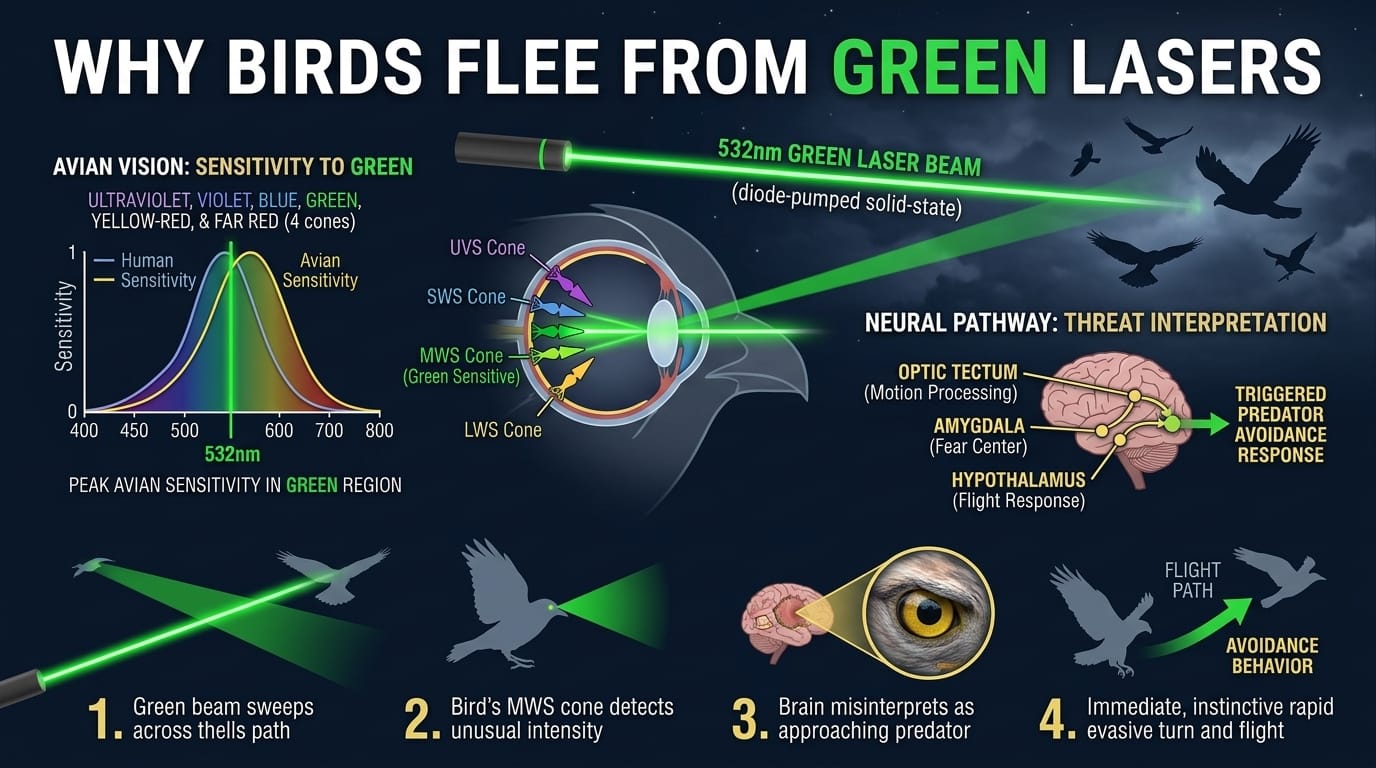
The success of green laser bird control is rooted in avian biology. Birds have highly advanced visual systems, processing light and motion much faster than humans. When a concentrated 532nm green laser beam hits a surface near a bird, their brains perceive the rapidly approaching bright dot as a physical, solid object.
Because the green spectrum (532nm) is incredibly bright and distinct against natural backgrounds, birds view the moving laser beam as a fast-approaching predator or an active threat. Their instinctual response is to flee the area immediately.
What makes this especially fascinating is the difference between avian and human vision. Birds possess four types of color-sensitive cone cells in their retinas, while humans have only three. This tetrachromatic vision allows birds to perceive ultraviolet light and an expanded range of green spectrum sensitivity. When a 532nm laser strikes foliage or the ground, it reflects at a wavelength that sits squarely in the peak sensitivity range of most diurnal bird species. To a starling or a crow, that green dot isn't just a dot—it registers as something intensely vivid and alarming, almost like a lightning bolt frozen in motion.
Researchers at Wageningen University in the Netherlands conducted extensive field trials observing the behavioral response of corvids, gulls, and waterfowl to moving laser stimuli. Their findings confirmed that birds do not habituate to unpredictable laser movement over extended periods, whereas they rapidly learn to ignore static scarecrows, inflatable deterrents, and even recorded distress calls within days. The laser's unpredictability—its ability to zigzag, accelerate, and appear from any direction—mimics the erratic movement of a swooping raptor, keeping the birds perpetually on edge and unwilling to settle.
2. The Advantages Over Traditional Methods
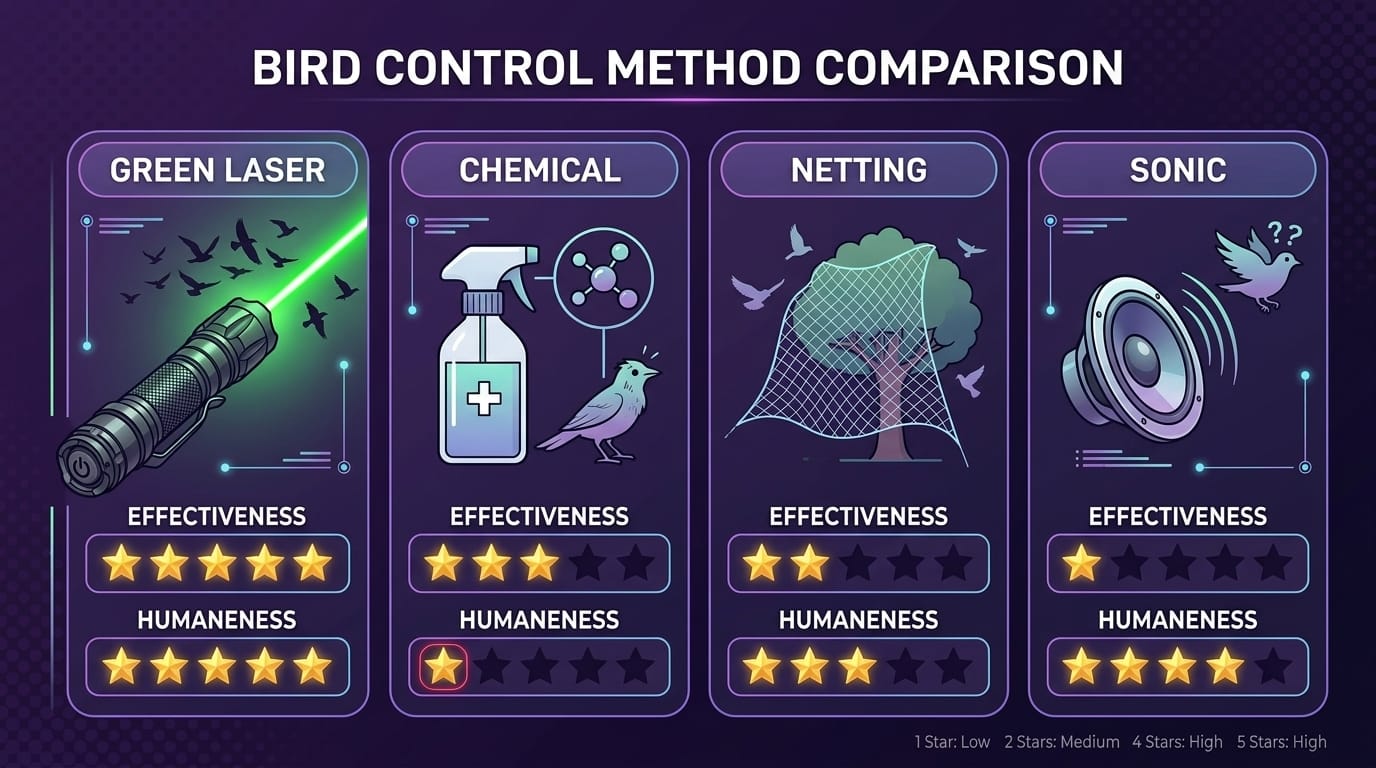
Traditional bird control methods often fail over time due to habituation or cause unnecessary environmental disruptions. A high-power green laser solves these persistent problems:
- Zero Noise Pollution: Unlike acoustic cannons or distress call speakers that annoy neighbors and violate local noise ordinances, lasers are 100% silent.
- No Habituation: Birds quickly learn that scarecrows or fake owls are harmless. Because a handheld laser pointer can be moved erratically in unpredictable patterns by the user, birds never get "used" to the threat.
- Unmatched Range: A premium tactical green laser can effectively project a bright deterrent spot over 6000 feet away, allowing you to sweep an entire orchard or warehouse roof from a single stationary position.
- Complete Non-Toxicity: Chemical bird repellents often leave residue on crops, contaminate groundwater, and may violate organic farming certifications. A laser beam leaves absolutely no chemical footprint, making it the cleanest deterrent available—safe for your produce, your soil, and the broader ecosystem.
- Instantaneous Deployment: There is no setup time, no netting to install, and no structures to maintain. You can pick up your laser and begin clearing an area within seconds, a critical advantage when a massive flock descends unexpectedly on your field.
- Year-Round Versatility: While netting degrades under UV exposure and propane cannons freeze in winter, a quality tactical laser functions reliably in temperatures from below freezing to intense summer heat, provided you use aerospace-grade construction.
Beyond these practical advantages, there is an important ethical dimension. Across Europe, regulations increasingly restrict lethal bird control methods, and consumers are demanding that food producers adopt humane practices. Laser deterrence aligns perfectly with these evolving standards, allowing farmers to protect their livelihoods while maintaining a compassionate, environmentally responsible approach to wildlife management.
3. Best Practices for Safe and Effective Sweeping
To maximize your success while maintaining safety, never shine the laser directly into a bird's eyes. Instead, aim the laser at the ground or foliage near the flock and rapidly sweep the beam *towards* them. This triggers their flight reflex without causing any retinal damage.
Additionally, sweeping at dawn or dusk—when nuisance birds are actively foraging or looking to roost—yields the highest success rate, as the green beam's contrast is most intense during lower light conditions.
The effectiveness of your sweeping technique matters as much as the laser itself. Begin by sweeping the beam in wide, slow arcs across the ground at least 30 to 50 feet away from the birds, then gradually narrow your pattern as they become alert. The goal is to create a growing sense of encroachment—a simulated predator closing in. Avoid rapid, jerky motions that can scatter birds in chaotic directions; a controlled, deliberate sweep encourages the entire flock to lift off together and depart in an organized manner, reducing the chance that they simply relocate to another corner of your property.
Weather conditions also play a significant role. On overcast days, the laser beam's visibility against darker skies is naturally enhanced, allowing effective deterrence even during midday hours. In full, harsh sunlight, however, you may need a higher-output laser (typically 50mW or above) to maintain a visible deterrent dot at distance. Experienced operators often pair their laser use with basic weather monitoring—knowing when fog, cloud cover, or twilight conditions will amplify the laser's intimidating presence can dramatically improve your results.
4. Species-Specific Strategies for Maximum Effectiveness
Not all pest birds respond identically to laser deterrence, and understanding the behavioral profiles of your target species can significantly improve your success rate.
Crows and ravens, being among the most intelligent avian species, are initially highly reactive to laser sweeps but may attempt to test the boundaries of the threat over time. For corvid-heavy environments, vary your sweeping schedule irregularly—appearing at unpredictable times and approaching from different angles keeps these clever birds from mapping your patterns. Starlings, on the other hand, rely heavily on flock coordination; sweeping through the center of a starling murmuration at dusk can trigger a mass departure that clears the entire formation in under a minute.
Gulls and waterfowl present a different challenge, particularly in coastal or marina settings. These birds are highly territorial and less easily intimidated by ground-level sweeps. For gulls, the most effective technique involves sweeping the laser across elevated structures—rooftops, light poles, and dock pilings—where they typically perch, forcing them to abandon their roosting positions. Geese respond best to dawn patrols, as they gather on open grass near water bodies before their morning foraging flights.
Pigeons, commonly problematic in urban and warehouse environments, are perhaps the easiest to deter. Their strong flocking instinct means that clearing even a small percentage of a roosting group with persistent laser sweeps often convinces the entire colony to abandon the site permanently. Many warehouse managers report that a one-week intensive laser protocol—sweeping roosting areas for 15 minutes at dawn and dusk—results in a permanent colony relocation.
5. Real-World Applications Across Industries
The versatility of green laser bird deterrence extends far beyond agricultural fields. Across industries, professionals are discovering that this silent technology solves problems that traditional methods simply cannot address.
Aviation Safety: Bird strikes pose a serious threat to aircraft during takeoff and landing. Airports in Europe and North America have begun integrating green laser systems into their wildlife management protocols. Ground crews can sweep runways and surrounding grasslands from control towers or patrol vehicles, quickly dispersing flocks of gulls, geese, and pigeons without disrupting air traffic with loud pyrotechnics.
Solar Farm Maintenance: Solar panel arrays provide ideal roosting surfaces for pigeons and crows, whose droppings reduce panel efficiency by blocking sunlight and corroding surfaces. Traditional bird spikes and netting are expensive to install across hundreds of acres of panels. A single operator with a high-power green laser can patrol a solar installation daily, preventing birds from ever establishing roosting habits on the valuable equipment.
Historic Building Preservation: Acidic bird droppings cause millions of dollars in damage to historic stonework, cathedrals, and monuments each year. Laser deterrence allows preservation teams to keep pigeons off delicate masonry without installing visually intrusive netting or spikes that would compromise the aesthetic integrity of heritage sites.
The Verdict: The Ultimate Eco-Friendly Deterrent
Protecting your property doesn't require harsh chemicals or disruptive noise. By leveraging the biological instincts of nuisance birds, a 532nm tactical green laser pointer provides a silent, highly effective, and entirely humane perimeter defense system.
From the smallest backyard garden to the largest commercial vineyard, the technology scales effortlessly. What was once the domain of research laboratories has matured into an accessible, reliable, and cost-effective solution for anyone who needs to keep birds at bay. In an era where environmental consciousness and humane practices matter more than ever, the green laser stands as a testament to what is possible when we work with nature's design rather than against it.
Secure Your Property Silently
Upgrade your pest control strategy today. Discover the 6000ft range tactical green laser and protect your crops and property with precision light.
Shop the Laser Bird Deterrent Now