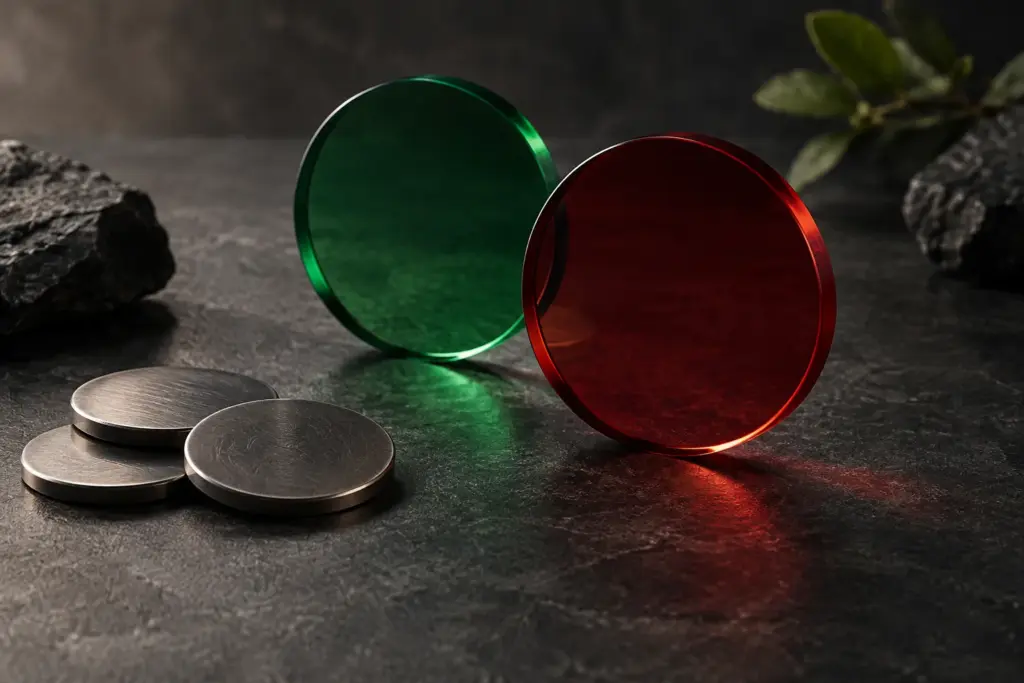
Green vs. Red Laser Pointers: The Ultimate Tactical Showdown

If you are looking to buy a laser pointer for stargazing, camping, or tactical use, you've probably hit the classic dilemma: Should I get a red one or a green one?

While red lasers are cheap and everywhere (you probably use one to play with your cat), green lasers are often marketed as premium, tactical gear. Are they really worth the upgrade? Let's break down the ultimate showdown between green and red lasers to help you make the right choice.

A Brief History of Laser Colors

Red lasers came first. Theodore Maiman's 1960 ruby laser produced deep red light at 694nm, and for the next two decades, red was essentially the only game in town for compact laser technology. The first commercial laser pointers in the 1980s were helium-neon gas lasers—bulky, power-hungry, and fragile. The development of red semiconductor laser diodes in the late 1980s made pocket-sized laser pointers possible, and overnight they became ubiquitous in conference rooms and lecture halls worldwide.

Green lasers required an entirely different technological path. The first green laser pointers appeared commercially in the late 1990s, using a technique called diode-pumped solid-state (DPSS) frequency doubling. They were expensive—hundreds of dollars for a 1mW unit—and power-hungry, draining AAA batteries in under an hour. But the performance difference was immediately obvious. A 1mW green laser appeared brighter than a 5mW red laser, and for the first time, you could actually see the beam in the air, not just the dot on the wall.

Fast forward to 2026, and the landscape has shifted dramatically. While red lasers remain the budget option, green DPSS technology has matured to the point where affordable, high-power, durable tactical units like the Laser Beam Pro deliver performance that would have seemed like science fiction just 15 years ago. The price gap has narrowed, and for anyone planning to use a laser outdoors, the green premium is now a spectacular bargain rather than a splurge.

1. The Brightness Factor: Green Dominates

When it comes to pure, visible brightness, this isn't even a fair fight. As we've covered in our knowledge base, the human eye is biologically wired to be hyper-sensitive to the color green.

If you take a 5mW red laser and a 5mW green laser and point them side-by-side in the dark, the green laser will appear roughly 50 times brighter. With a red laser, you usually only see the little red dot on the wall. With a green laser like the Laser Beam Pro, you see the entire solid beam cutting through the air like a lightsaber. For outdoor visibility, green wins effortlessly.

Let me quantify this with actual numbers. The International Commission on Illumination (CIE) established the photopic luminosity function, which assigns a sensitivity value to each wavelength of visible light. At 532nm green, the sensitivity factor is approximately 0.88 (on a scale where 1.0 is the peak at 555nm). At 650nm red, the sensitivity factor plummets to roughly 0.107. That means, milliwatt for milliwatt, your eyes perceive green light as over 8 times brighter purely based on physiology. Add in the Rayleigh scattering advantage—where green scatters 4 times more strongly than red in the atmosphere—and the combined effect pushes perceived brightness to roughly 30-50 times greater for the beam itself.

A practical demonstration makes this crystal clear. Borrow a 5mW red presentation pointer and bring it outside on a moonless night. You will see a faint red dot on a treeline 200 feet away—barely. Now swap to a 5mW 532nm green laser. The difference is not just brightness; it is a completely different experience. The green beam writes itself across the air like a glowing rod, and the endpoint visibly illuminates the target. This is not a marketing claim; it is demonstrable physics that anyone can verify in under five minutes.

2. Range and Distance: Reaching the Stars

Because the green wavelength (532nm) scatters differently in the atmosphere and is picked up so well by our eyes, its effective range destroys red lasers.

  • Red Lasers: Typically max out at a few hundred feet. They are great for indoor presentations or annoying your pets, but useless if you need to point out a distant landmark.
  • Red Lasers at Night: In absolute darkness, a strong 5mW red laser's beam may be faintly visible for perhaps 1000 feet under ideal conditions. But you will never get the solid "lightsaber beam" effect—only the endpoint dot and a very faint, barely perceptible trace. For practical group use, the effective teaching range is under 100 feet.
  • Green Lasers: A tactical green laser can reach up to 6000 feet (over a mile) at night. This massive range makes green the undisputed king for astronomy, allowing you to literally point out constellations to a group of friends.
  • Green Lasers in Practice: Under typical night conditions with moderate humidity and clear skies, expect a clearly visible beam column for 2000-3000 feet and an observable endpoint dot at the full rated 6000-foot distance. With binoculars at the far end, the dot remains crisp and easily identified even at maximum range.

3. Manufacturing and Durability

Red lasers are extremely cheap to manufacture because they use a simple, single diode. That's why you can buy them at a gas station for three dollars.

Green lasers require a much more complex internal structure, often using crystals to convert infrared light into that stunning 532nm green beam. Because the internal components are more premium, green lasers are usually housed in much tougher, tactical-grade bodies. For example, our green laser is wrapped in aerospace-grade aluminum alloy, making it shockproof and water-resistant—something a cheap plastic red laser could never handle.

The DPSS pathway that green lasers use represents a fundamentally different engineering challenge than red diode lasers. A red laser is essentially a single component: apply current to a semiconductor diode, and red light emerges directly. A green DPSS laser has a minimum of three precision-aligned components—pump diode, gain crystal, and frequency doubler—all of which must maintain sub-micron alignment. This complexity drives up manufacturing cost but also forces build quality to be inherently higher. You simply cannot make a functional DPSS green laser in a flimsy plastic housing; the crystal alignment would shift from the thermal expansion of the plastic alone.

Quality control is another invisible cost that separates tactical green lasers from cheap alternatives. Every unit in a professional line undergoes power output testing, wavelength verification with a spectrometer, beam divergence measurement, and stability testing over temperature cycles. Cheap red lasers typically get a simple "does it turn on?" check. When you pay for a tactical green laser, a significant portion of that cost represents the units that were rejected during quality testing and never reached a customer.

The Verdict: Which Should You Buy?

If you just need something to play with indoors, save your money and buy a $5 red laser. But if you are heading outdoors, going camping, exploring the night sky, or you just want a genuinely powerful, professional piece of gear, green is the only way to go.

Here is the summary comparison I wish someone had shown me years ago:

  • Brightness: Green appears 50x brighter than red at equal power. Not a debate—pure human physiology.
  • Beam Visibility: Green creates an entire visible beam column through Rayleigh scattering. Red only shows the endpoint dot.
  • Effective Range: Green reaches 6000+ feet on a dark night. Red struggles past 500 feet.
  • Durability: Green lasers command quality aerospace-grade aluminum construction. Red lasers are almost always cheap plastic housings.
  • Battery Life: Green requires more power due to DPSS inefficiency, but rechargeable lithium-ion cells eliminate the recurring cost problem.
  • Use Case Flexibility: Green works for astronomy, survival signaling, navigation, and teaching. Red works for presentations and pet toys.

The decision really comes down to one question: are you going outside or staying inside? Everything else follows from that answer.

4. Use Case Showdown: Red Wins Some Battles

Green dominates outdoor applications, but I want to be fair here—red lasers do have legitimate use cases where they make more sense. Here is an honest breakdown of when each color shines:

  • Indoor Presentations: Red wins easily. A 1mW red laser is perfectly visible in a conference room, costs under $10, and poses minimal eye hazard. Using a 5mW tactical green laser indoors is overkill—the beam can be distractingly bright and risks eye injury in confined spaces.
  • Pet Toys: Red lasers are ubiquitous for a reason. Cats respond well to the red dot, and the lower power output makes them inherently safer for indoor play. Green lasers are too bright for pet use and can cause anxiety or eye damage.
  • Classroom Teaching: Red laser pointers have been a staple of lecture halls for decades. They are cheap, reliable, and safe. Unless you are teaching astronomy or outdoor geology, red is the practical choice.
  • Budget-Conscious Astronomy: If you observe alone and know exactly where to point, a good-quality red laser finder mounted on your telescope works fine. It is only when you need to show others or push beyond a few hundred feet that green becomes essential.

So yes, red lasers have their place. The key distinction is this: red is a pointer, green is a tool. If you need to indicate something on a whiteboard, go red. If you need to illuminate a landmark 2000 feet away, survive a night in the wilderness, or lead a group stargazing session, only green delivers.

5. The Total Cost of Ownership Question

At first glance, the price difference looks dramatic. A red laser costs five dollars at a convenience store. A quality tactical green laser costs significantly more. But this is a classic case of false economy. Let me show you why.

Over my ten years of heavy outdoor use, I went through roughly 30 cheap red and low-quality green pointers before buying my Laser Beam Pro. Each failed in a different way: battery contacts corroded, plastic housings cracked, diodes misaligned, moisture seeped in. At an average of $8-12 each, I spent well over $300 on disposable pointers. My current tactical green laser has lasted four years and counting. The math is simple: buy once, cry once.

Then there is the battery cost. Those cheap pointers use coin cells or AAA batteries that die within hours and need constant replacement. At $4-6 per pack, a few stargazing sessions can eat through $20 in batteries alone. The Laser Beam Pro uses a rechargeable 18650 lithium-ion cell that costs pennies per charge and lasts an entire night of continuous use. Over a year of regular use, the rechargeable system pays for itself purely in battery savings.

Upgrade to Tactical Green

Experience the 50x brightness advantage. Get the ultimate 6000ft range green laser pointer with a rugged aluminum body and rechargeable battery.

Shop the Laser Beam Pro
Light Tracer Laser Pointer Thumbnail

Light Tracer Laser Beam Pro

$19.99 $39.99
Ends:
00:00:00