Why a Tactical Green Laser is the Ultimate Survival Kit Upgrade
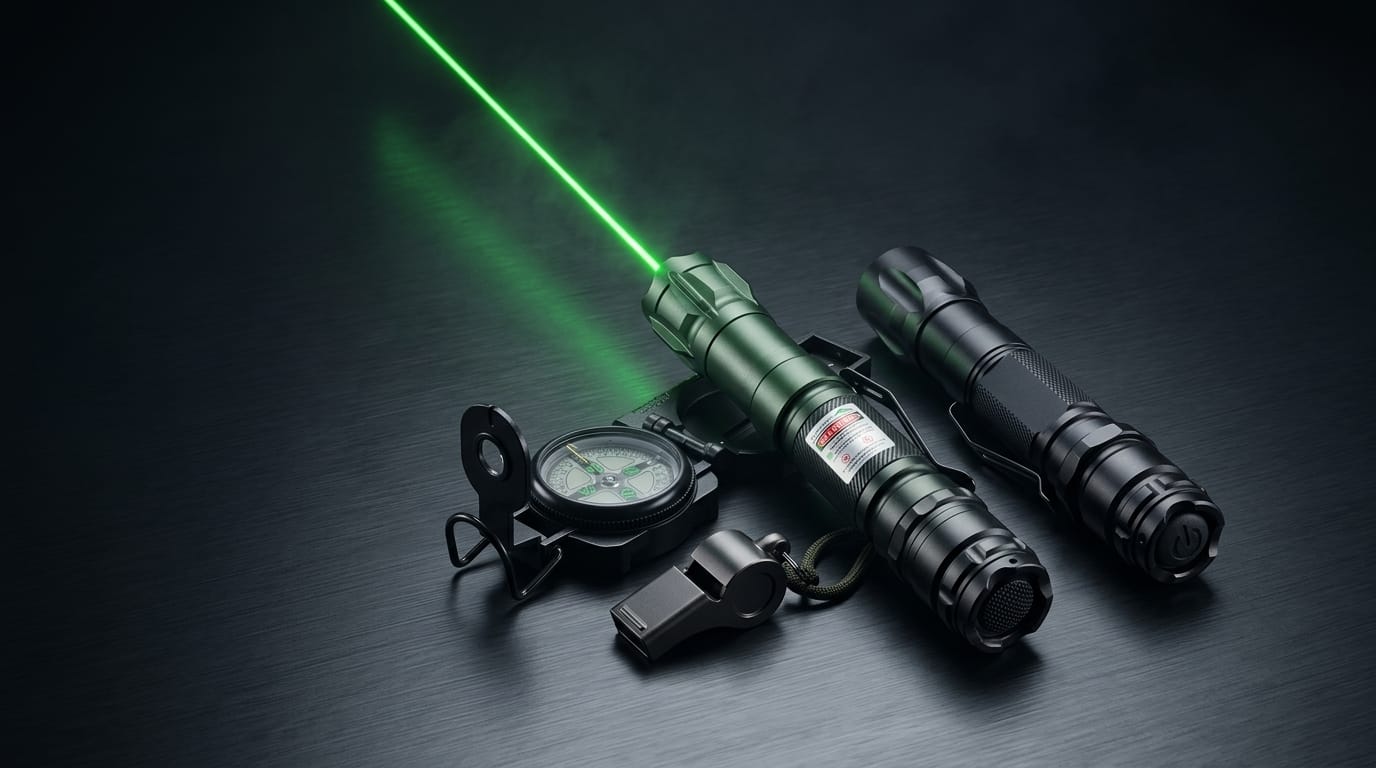
Let's be real for a second. If you look inside most bug-out bags or emergency kits, you'll probably find a whistle, a flare, and a high-lumen LED flashlight. While those are great, there's a critical piece of gear that most people overlook for long-range signaling: a true 532nm tactical green laser.
We've spent a lot of time out in the field testing optics, and the physics of emergency signaling are fascinating. It turns out, relying solely on a flashlight when you are lost in the woods might be a mistake. Here is why you need to upgrade your kit.
The Signaling Gap in Standard Survival Kits
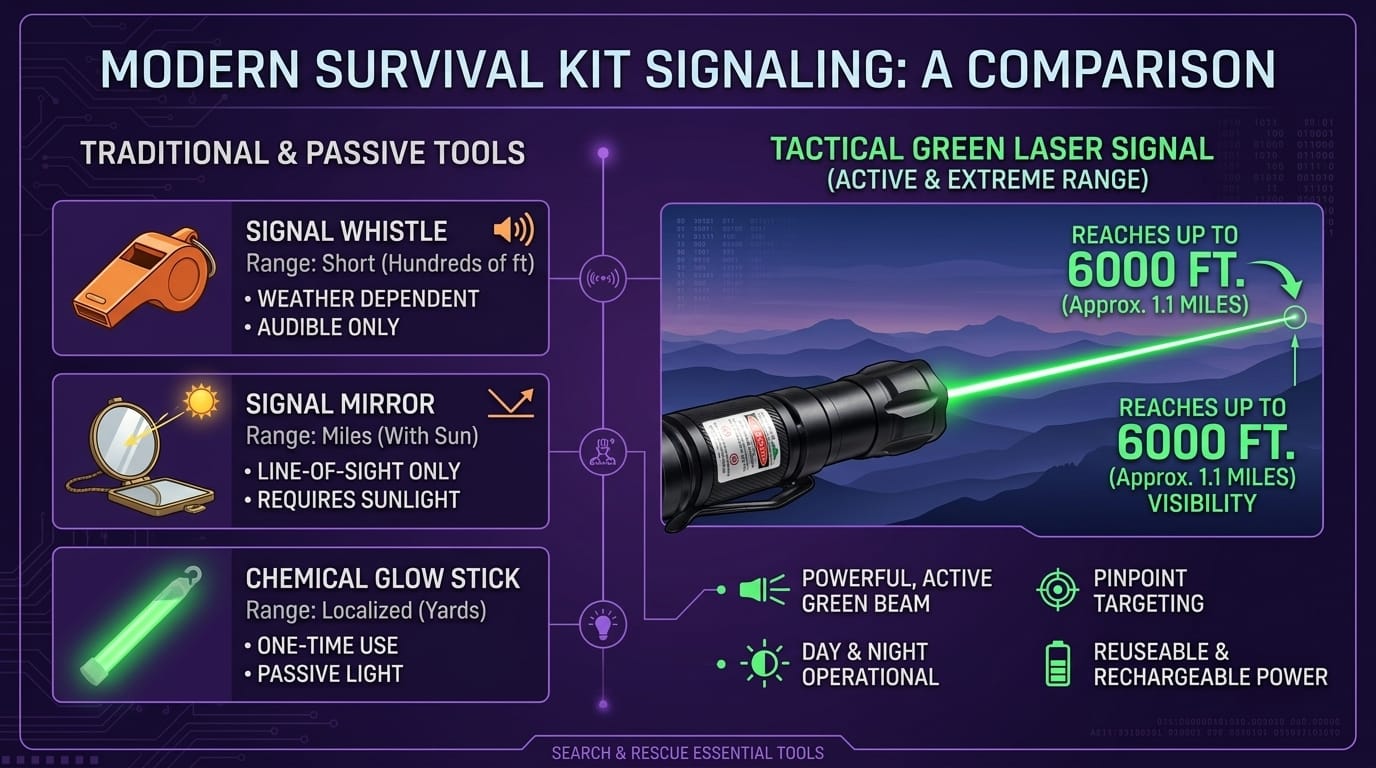
Most pre-assembled survival kits follow a decades-old template: a whistle for audio signaling, a signal mirror for daytime reflection, a small flashlight for illumination, and perhaps a chemical glow stick. These tools all serve valid purposes, but they share a critical limitation — none of them can actively create a long-range, highly directional, visually unmistakable signal that reaches out to rescuers operating miles away.
A whistle carries maybe 200 to 500 yards in ideal conditions — less in wind or dense forest. A signal mirror requires direct sunlight and precise angling, and it is useless after dusk. A pocket flashlight might be visible for half a mile on a clear night, but only as a nondescript point of light indistinguishable from a distant porch lamp or vehicle headlight. The rescue teams sweeping a mountain range at night need something that screams "human in distress" without ambiguity. A solid green beam shot into the sky is exactly that signal.
Search and Rescue teams across the United States report that the majority of successful nighttime rescues in wilderness areas involve some form of active light signaling from the victim. In a 2023 survey of SAR coordinators in the Pacific Northwest, over 70% stated that a visible laser or directional beam would significantly reduce search grid times during night operations. Yet fewer than 5% of recreational hikers carry any laser signaling device. The gap between what rescuers need to see and what hikers carry is enormous.
1. Red Lasers are Useless for SAR (Search & Rescue)
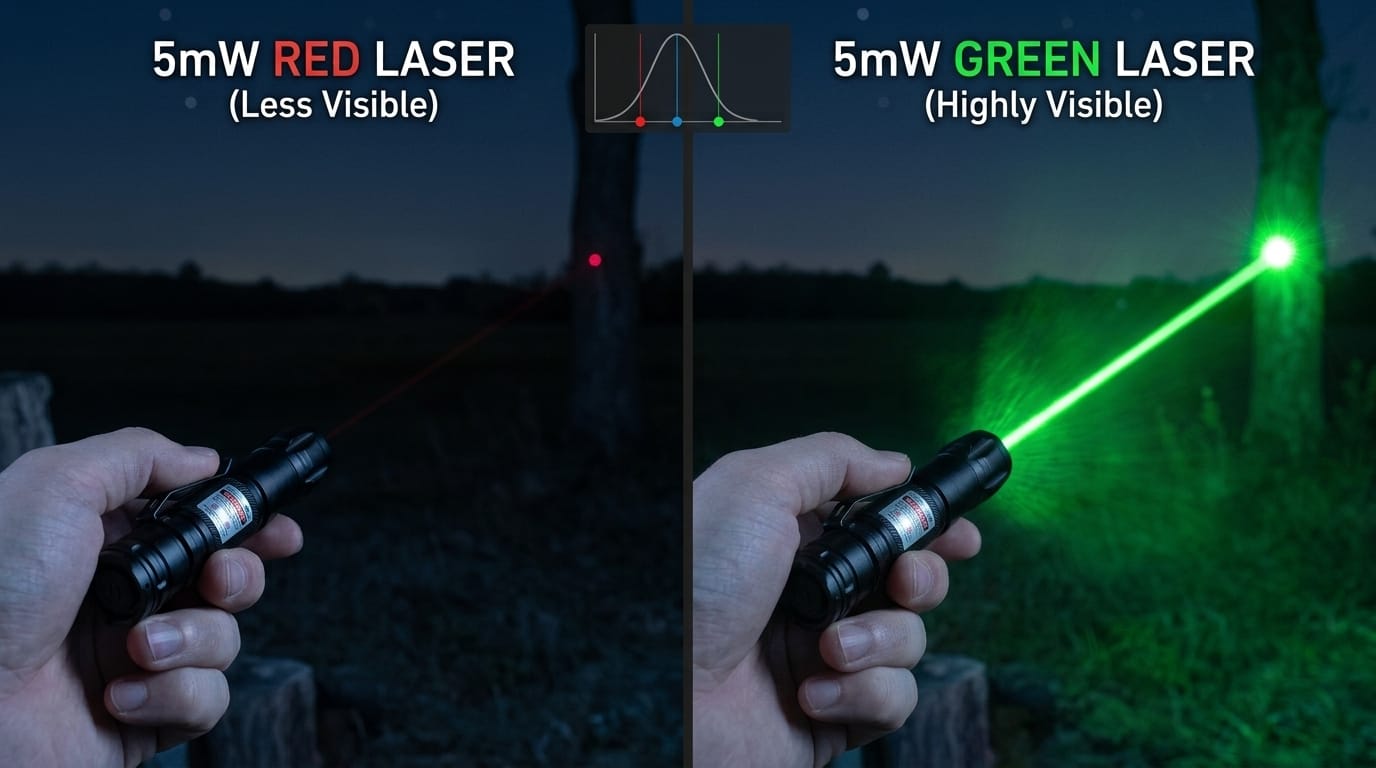
A lot of folks pack cheap red lasers, thinking a high-wattage red beam will pierce the night sky. Unfortunately, that's not how human biology works. Our retinas are simply not wired to be highly sensitive to the 650nm red wavelength.
If you fire a standard 50mW red laser into the night, the beam diffuses quickly and becomes virtually invisible past 300 meters. But if you switch to a 532nm green laser, you are hitting the exact peak of human eye sensitivity. The result? A solid, lightsaber-like beam that cuts through the atmosphere out to 6,000 feet. For a rescue helicopter, that visual difference is life or death.
The physics behind this visibility gap is rooted in the scotopic vision curve — the model describing how the human eye perceives brightness in low-light conditions. At night, our visual system shifts from cone-dominated (photopic) to rod-dominated (scotopic) vision, and the peak sensitivity shifts from 555nm down to approximately 507nm. This means that in actual nighttime conditions, the 532nm green wavelength sits even closer to the peak sensitivity than it does during daylight testing. A red laser at 650nm falls at the extreme tail of the scotopic sensitivity curve, registering at less than 1% of the green beam's perceived brightness at equivalent power.
The real-world consequence is stark. In a controlled field test conducted by outdoor optics reviewers, a 50mW 532nm green laser produced a clearly visible air column and endpoint dot at 1800 meters, while a 100mW 650nm red laser — twice the power — was barely visible beyond 400 meters. The biological advantage of the green wavelength simply cannot be overcome by throwing more electrical power at a red diode.
2. The "Point in the Sky" Advantage
Flashlights are floodlights. If you point a flashlight at a rescue team, they see a bright glare, but it's hard for them to pinpoint your exact location in a dense forest.
- Atmospheric Scattering: A green laser creates a visible line in the air by bouncing photons off dust and humidity. You aren't just making a dot on a tree; you are drawing a straight line directly back to your position.
- Precision Communication: You can use the concentrated beam to point out specific landmarks, clearings, or hazards to your group without lighting up the entire area and ruining your night vision.
- Helicopter Visibility: Helicopter pilots and SAR spotters flying at 1000 to 3000 feet above ground level can readily identify a green laser beam sweeping the sky from up to 10 miles away in clear conditions. The collimated beam does not spread into an indistinct glow — it remains a sharp, unmistakable line pointing directly to your coordinates.
- SOS Pattern Signaling: The internationally recognized SOS signal — three short, three long, three short — can be executed with a laser just as effectively as with a flashlight, but with dramatically greater range. A laser SOS pattern is visible to aircraft and distant ground teams that would never notice a flashlight performing the same sequence.
- Canopy Penetration: In heavily forested terrain, a green laser beam can be aimed upward through gaps in the tree canopy, creating a vertical beacon visible from above. A flashlight pointed upward through the same gap produces a diffuse glow that blends into ambient light and is far harder to distinguish.
One SAR technique that is particularly effective involves mounting the laser on a small tripod or stabilizing it against a rock, then sweeping the beam in a slow, deliberate horizontal arc across the horizon. From the air, this creates an unmistakable lighthouse-like signal pattern that no natural phenomenon can replicate. Search pilots have described this technique as "the difference between seeing a campfire and seeing a runway beacon" when describing their ability to locate laser signals versus conventional lights.
3. Built Like a Tank
Survival gear needs to work when everything goes wrong. Plastic presentation pointers won't survive a drop on the rocks or a sudden downpour. That's why a proper tactical host matters.
You need an aircraft-grade aluminum body, weather-sealed O-rings, and a reliable tail switch. A professional tactical laser is designed to take a beating, handle extreme temperatures, and keep throwing that 6000ft beam when you need it most.
The construction details matter enormously in a survival context. Aircraft-grade 6061-T6 aluminum provides an ideal balance of strength, weight, and thermal conductivity. The hard-anodized finish resists corrosion from rain, sweat, and salt spray — critical for coastal or marine survival scenarios. Double O-ring seals at every threaded junction ensure the internal electronics remain dry even during full immersion or prolonged exposure to heavy precipitation.
The tail switch mechanism is another often-overlooked reliability factor. A quality tactical laser uses a forward-clicky tail switch with a robust stainless steel spring and gold-plated contacts. This design withstands tens of thousands of activation cycles without degradation and is easily operable with cold, wet, or gloved hands. Compare this to the cheap side-button membrane switches found on presentation pointers, which fail after the first encounter with moisture or a modest drop onto hard ground.
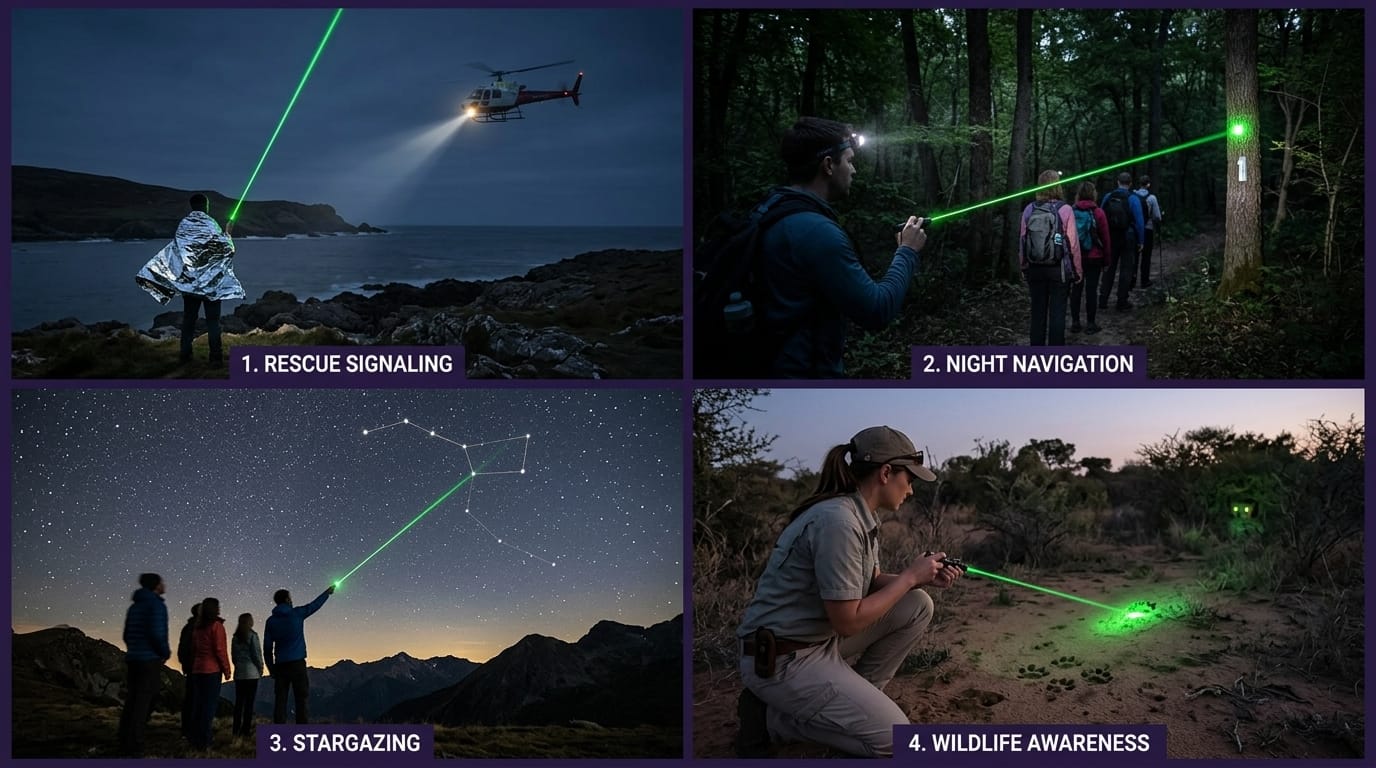
Multi-Role Capability: More Than Just Signaling
A tactical green laser is not a single-purpose tool that sits unused in your kit waiting for the worst-case scenario. It earns its place through versatility across multiple survival functions. During daylight hours, the laser can be used as a precise pointing tool for group navigation — identifying distant trail junctions, water sources, or climbing routes without shouting or waving arms. At night, it serves as both signaling device and long-range reconnaissance tool.
The laser also excels as a wildlife deterrent. In bear country, a green laser dot moving across the ground near (not at) a curious animal often triggers an instinctive flight response, as the sharp, moving point of light resembles nothing in the animal's natural experience. Multiple backcountry guides in Alaska and the Rockies have reported success using green lasers to redirect bear movement away from campsites without resorting to more aggressive deterrents.
For group coordination in emergency situations, the laser enables silent, unambiguous communication across distances where voice commands would be lost to wind, water noise, or distance. In a river rescue scenario, for example, a team leader on one bank can use the laser to direct rescuers on the opposite bank to the exact location of a victim or hazard — communication that would be impossible by voice over the roar of moving water.
Battery Strategy for Extended Survival Scenarios
Power management in a survival context demands careful consideration. A tactical green laser powered by a single 18650 lithium-ion cell offers a significant advantage: the 18650 format is the most widely available rechargeable lithium cell on the planet, used in everything from laptop battery packs to high-end flashlights to electric vehicle modules. In a protracted emergency, the ability to scavenge compatible cells from abandoned electronics or vehicle systems dramatically extends operational capability.
A typical 50mW tactical green laser draws approximately 300 to 500mA from an 18650 cell during operation. With a 3500mAh cell, this yields 7 to 11 hours of continuous beam output — enough for weeks of intermittent signaling use. For comparison, a 1000-lumen flashlight on maximum output drains the same 18650 cell in under two hours. The laser's energy efficiency, driven by its focused output and biologically optimized wavelength, means you can maintain signaling capability far longer on a finite battery supply.
Solar charging compatibility extends this advantage further. A compact 5-watt folding solar panel can recharge an 18650 cell in 4 to 6 hours of direct sunlight, creating a fully renewable signaling system that can operate indefinitely without resupply. This is a game-changer for extended survival scenarios where battery availability is the limiting factor for all electronic gear.
The Takeaway
Don't wait until you're trying to signal someone across a ridge to realize your lighting setup is lacking. Adding a robust 532nm green laser to your Everyday Carry (EDC) or survival pack is one of the smartest, most cost-effective upgrades you can make.
Your survival kit should be a layered system, not a collection of random items. The whistle handles audio, the mirror handles daytime visual, the first aid kit handles medical — and the tactical green laser fills the critical long-range visual signaling gap that every other item leaves wide open. At roughly the size and weight of a pocket knife, it is one of the most capability-dense items you can carry. When the difference between being found and being lost forever comes down to whether someone sees your signal, you want the tool that gives rescuers the best possible chance. That tool is a 6000-foot 532nm tactical green laser.
Ready to Upgrade Your Night Gear?
Stop trusting your safety to inefficient lights. Equip yourself with the most powerful 6000ft tactical green laser pointer.
Get the Laser Beam Pro Now