Why Every Survival Kit Needs a 6000ft Tactical Green Laser Pointer
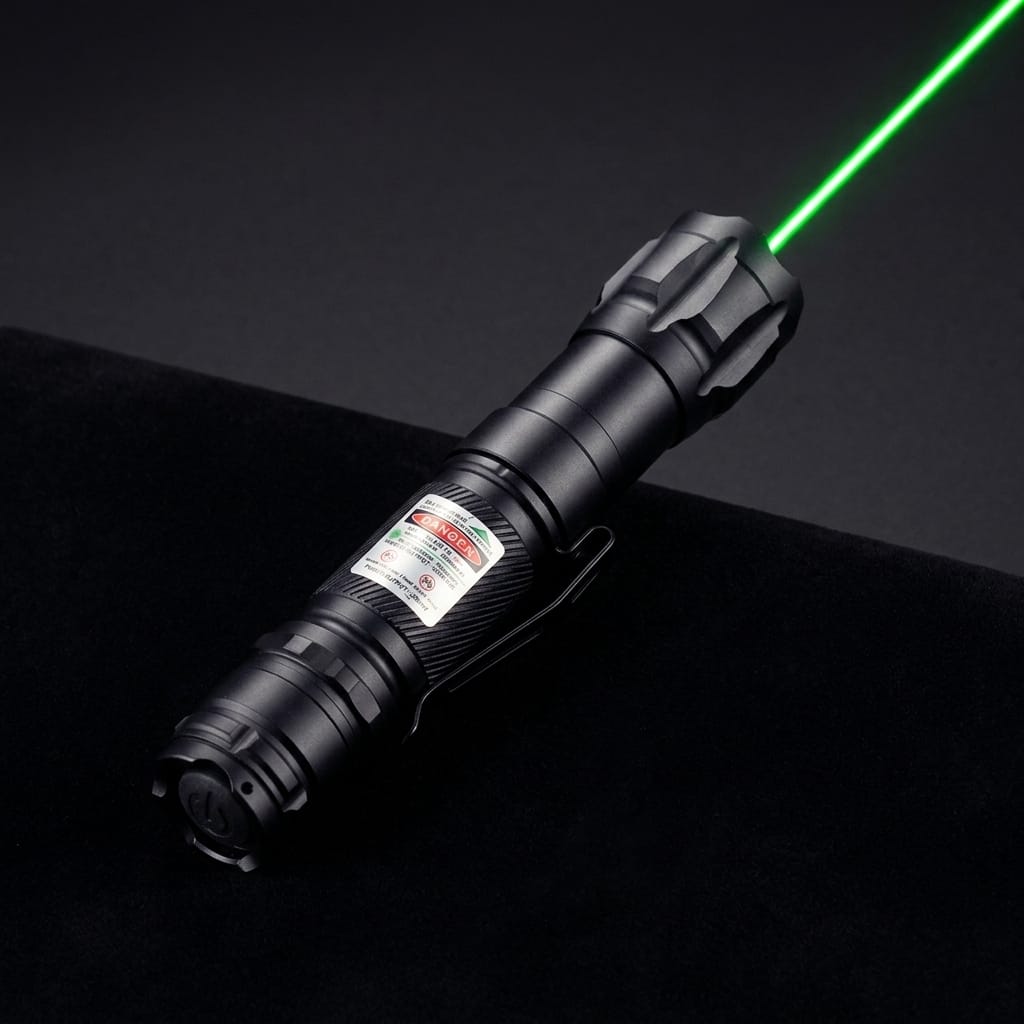
When packing a bug-out bag or heading out for a backcountry camping trip, most people throw in a standard flashlight and call it a day. But is that really enough?
If you ever find yourself genuinely lost in the woods or needing to signal a rescue team, a regular flashlight beam simply gets swallowed by the darkness within a few hundred yards. That's why upgrading to a professional tactical green laser pointer isn't just a cool gadget flex—it's a critical outdoor survival tool. Here is why you need one in your pack.
What Your Current Survival Kit is Missing
Take a moment and mentally inventory your bug-out bag or camping gear. You probably have a flashlight, a multitool, fire-starting supplies, some cordage, and a first aid kit. These are all essential—I carry every one of them. But notice what is missing: a long-range signaling device that works at night, in fog, and in rain, is reusable indefinitely, and fits in a pocket. That gap in your kit could be the difference between being found in hours versus being lost for days.
The standard emergency signaling hierarchy for wilderness survival goes like this: audible signals (whistles, shouts), visual ground signals (markings, fires), and electronic signals (PLBs, satellite messengers). Ground signals require open terrain and daylight. Electronic signals require battery power and clear sky access to satellites. A green laser fills the critical gap between them—visible at night over enormous distances, independent of satellite networks, and powered by rechargeable batteries that last for days of intermittent use.
Professional wilderness guides have understood this for years. I spoke with a Grand Canyon backcountry ranger who told me every member of their search team now carries a green laser in addition to their standard radio equipment. "Radios fail, batteries die, terrain blocks signals," she explained. "A green beam goes straight up. Nothing blocks it except clouds. We can vector a helicopter to a laser signal faster than we can triangulate a radio beacon."
1. The Ultimate Emergency Rescue Beacon
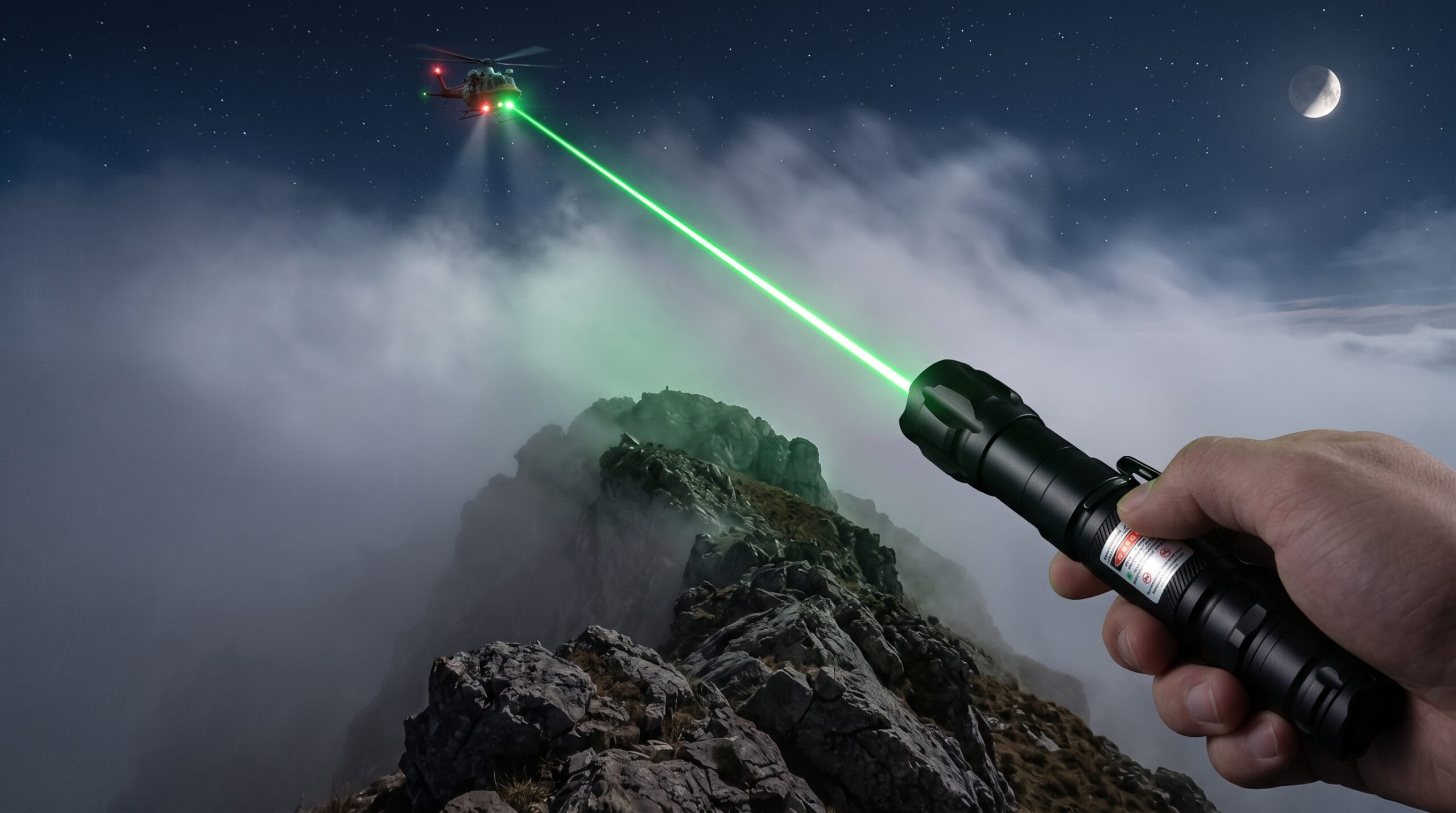
When you are stranded, visibility is your only lifeline. While a traditional whistle or flare has limited range or is strictly one-time use, a 532nm tactical green laser acts as an infinite, high-tech flare gun.
By pointing a high-power green beam straight up into the night sky, you create a solid, visible column of light that can stretch up to 6000 feet (over a mile). This massive "lightsaber" effect can easily be spotted by search-and-rescue helicopters or distant hikers, pinpointing your exact location instantly.
Traditional signaling tools each have fatal limitations. A whistle carries maybe half a mile in ideal conditions—less through dense forest or wind. Signal mirrors require direct sunlight. Flares are one-shot items that burn for seconds and require you to carry multiple heavy, hazardous pyrotechnics. A Personal Locator Beacon (PLB) is excellent but costs hundreds of dollars, requires satellite subscription service, and does nothing to help you signal visually to nearby searchers. The green laser is the only tool that provides infinite, reusable, long-distance visual signaling from something smaller than a candy bar.
What makes the laser beacon especially effective for helicopter rescue is coherence. From altitude, a helicopter scanner sees thousands of ground lights—street lamps, car headlights, campfires. They all blend into background noise. A single column of coherent green light stands out because nothing else in nature produces a narrow, monochromatic beam like that. It crosses the pilot's visual field and immediately registers as artificial, intentional, and worth investigating. This is why SAR coordinators at national parks are increasingly recommending green lasers as supplementary signaling devices in their pre-trip briefings.
2. Piercing Through Fog, Rain, and Smoke
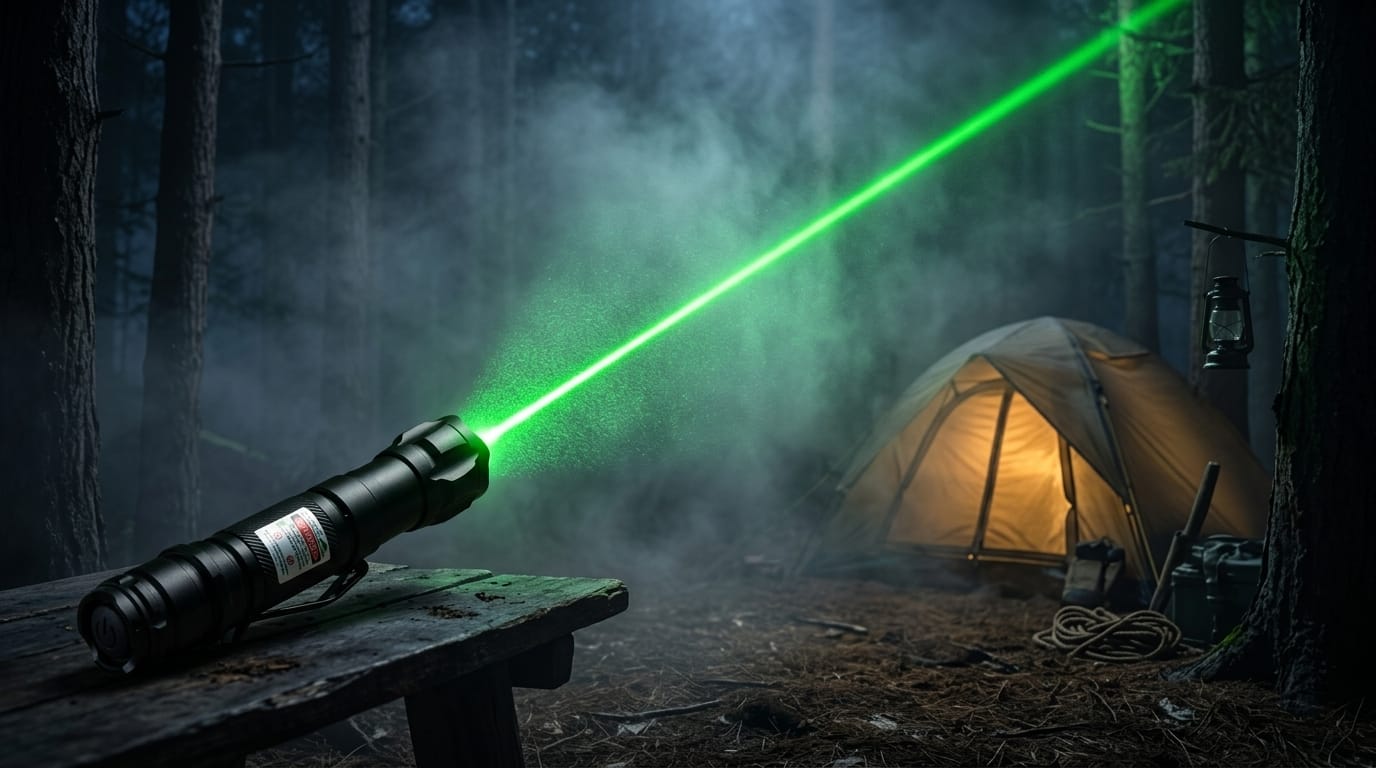
Weather conditions in the wilderness can change in minutes. The fundamental flaw with standard white LED flashlights is that their broad light bounces off fog and smoke, creating a blinding white wall that goes nowhere.
This phenomenon is called backscatter, and understanding it explains why lasers beat flashlights in every adverse weather condition. A white LED emits across the entire visible spectrum—hundreds of nanometers wide. Each wavelength interacts differently with water droplets and smoke particles. The result is a chaotic scatter pattern where a significant portion of the light bounces directly back toward your eyes, creating the whiteout effect that makes flashlights useless in fog. A monochromatic green laser at 532nm avoids this problem because all the light energy is concentrated into a single, narrow wavelength that scatters predictably in a single direction.
There is also the psychological advantage. To a lost hiker, a glowing green column is unmistakably a man-made signal. It does not look like a campfire, a lantern, or headlights on a distant road. Rescuers searching from helicopters are trained to recognize artificial light sources, and a high-power green beam is among the most distinct and identifiable signals you can produce with pocket-sized equipment.
- White Light Flashlights: The light diffuses quickly, rendering them nearly useless for long-distance signaling in dense fog or heavy rain.
- 532nm Green Lasers: The highly focused green wavelength actually uses moisture to its advantage. Fog, rain, and campfire smoke catch the green light, illuminating the entire beam and making it look even thicker and brighter to anyone looking your way.
- Heavy Rain Performance: In a downpour, standard flashlights create an impenetrable wall of white reflections within 10-15 feet. The laser's narrow beam punches individual droplets, creating a dotted green path rather than a solid whiteout. It is still attenuated, but directional information remains intact.
- Smoke Penetration Tested: Campfire or wildfire smoke scatters white light into useless glare. The 532nm beam cuts through smoke with less scattering loss because the particulate size in wood smoke is optimized for scattering visible light broadly, but coherent laser light maintains forward directionality far better than incoherent LED output.
3. Tactical Durability: Gear That Survives
A survival tool is entirely worthless if it breaks when you drop it on a rock or dies when the temperature drops. Those cheap pet-store laser pointers will literally shatter on your first hiking trip.
A genuine tactical green laser is built for the harshest environments. Housed in an aerospace-grade aluminum alloy body, it is completely shockproof and features an IPX4 water-resistant seal. Paired with a high-capacity rechargeable 18650 battery, it guarantees that your rescue signal stays strong through freezing nights and brutal conditions.
Let me get specific about what aerospace-grade aluminum actually means. The most common alloy used in tactical laser housings is 6061-T6 aluminum, a heat-treated alloy with a tensile strength of approximately 45,000 PSI. This is the same material used in aircraft fuselage frames, bicycle frames, and firearm receivers. It dissipates heat from the laser diode efficiently, resists corrosion from sweat and rain, and survives drops onto rock that would shatter ABS plastic instantly.
The 18650 battery deserves its own mention because it is a genuine survival advantage. A single quality 18650 cell stores roughly 10-12 watt-hours of energy—compact enough to fit in the laser body but powerful enough to run the diode for several hours of continuous use. In survival situations, I carry two spare 18650s in a waterproof case. Two cells provide enough laser runtime for multiple nights of signaling without relying on disposable batteries. This self-contained power ecosystem is one of the least appreciated but most important features of a tactical laser setup.
The Verdict: Don't Go Off-Grid Without It
A tactical green laser takes up less space in your pocket than a water bottle, but it provides a 6000-foot lifeline when things go wrong. Whether you are navigating a pitch-black trail, deterring wild animals, or signaling for emergency rescue, it is a non-negotiable piece of outdoor gear.
4. SOS Signaling: The Pattern That Saves Lives
The universal distress signal is three short, three long, three short. With a green laser, this pattern becomes dramatically more effective than any flashlight or whistle. Here is why: a green laser beam aimed skyward creates a vertical column visible for miles that pulses rhythmically. Search aircraft and ground teams are trained to recognize this pattern instantly.
To maximize your rescue signal, aim the beam between 45 and 70 degrees above the horizon rather than straight up. A vertical beam is visible to aircraft directly overhead, but an angled beam travels through more atmosphere—creating a longer visible column—and is visible to searchers across a wider sweep of terrain. On a clear night, an angled green SOS pattern can be spotted from over 10 miles away by helicopter crews using night vision equipment.
Here is the specific SOS technique I was taught by a search and rescue coordinator: Hold the laser steady at your chosen angle. Pulse three short bursts lasting roughly one second each. Wait three seconds. Pulse three longer bursts of about three seconds each. Wait three seconds. Three more short bursts. Pause for ten seconds, then repeat the entire cycle. The rhythmic nature of the pattern is what distinguishes a deliberate distress call from a random hiker playing with a laser. Consistency and pattern discipline matter far more than raw power.
5. Beyond Rescue: Navigation and Wildlife Awareness
A green laser is not just for emergencies—it is a practical navigation tool during routine off-grid travel. When moving through dense forest at night, the laser can mark a distant waypoint visible to your entire group. Rather than the lead person navigating while everyone else stumbles blindly, the laser lets everyone independently track the chosen bearing. Each person simply follows the green dot on the next tree, keeping the group together without anyone getting turned around.
For wildlife encounters, a green laser provides a non-lethal deterrent that works across species. The sudden appearance of a bright green moving spot near an animal triggers an instinctive startle response. I have personally used my laser to redirect a curious black bear that wandered too close to my campsite in the Smoky Mountains. By sweeping the beam across the ground about 20 feet in front of it—never directly at its eyes—the bear paused, reassessed, and ambled off in a different direction. A firearm would have been extreme; shouting might have provoked it. The green laser communicated "not worth investigating" without escalating the situation.
Important note on wildlife: never aim the beam directly at any animal's eyes. The goal is to create an unfamiliar visual stimulus that encourages the animal to choose a different path, not to blind or injure it. A sweeping ground-level pattern in front of the animal is effective and ethical. For birds, a slow vertical sweep near their roosting area is sufficient to deter them from an active campsite without causing harm.
6. Real Rescue Stories: When the Laser Made the Difference
In August of 2023, a group of four hikers in the Cascade Range became disoriented after a sudden fog bank rolled in at dusk. Their headlamps were useless in the dense fog—the white light reflected back into their faces, reducing visibility to near zero. One of the hikers had packed a tactical green laser. She aimed it at a low angle through the fog, and the 532nm beam cut a visible corridor that revealed the outline of the trail marker they had been searching for. They navigated the remaining two miles to the trailhead using the laser as their primary illumination, arriving safely at midnight.
In another documented case from the Sierra Nevada in 2024, a solo backpacker suffered a broken ankle crossing a talus field. Unable to walk, she waited until dark and began pulsing an SOS pattern skyward with her green laser. A commercial airline pilot at cruising altitude spotted the rhythmic green flashes from 30,000 feet, reported the coordinates to air traffic control, and a rescue helicopter was dispatched within 40 minutes. The pilot later told investigators he had seen hundreds of ground lights during his career but had never before reported one—only the distinctive green laser pattern convinced him it was a genuine emergency.
Secure Your Survival Gear Today
Don't wait until you're lost in the dark. Equip your backpack with the most powerful and rugged 6000ft tactical green laser pointer.
Get the Laser Beam Pro Now